


Vigtigheden af icebreaker- og opvarmningsaktiviteter samt eksempler
Icebreakers og opvarmningsaktiviteter er en essentiel del af enhver non-formel læringsaktivitet og endnu vigtigere, når man arbejder med unge mennesker med færre muligheder. Disse aktiviteter forbereder deltagerne følelsesmæssigt, mentalt og nogle gange fysisk på at engagere sig i gruppen, aktivitetens tema og på at blive fortrolige med rummet og deres jævnaldrende. Samtidig udgør de en god, mental overgang fra hverdagslivet til workshoppens rum.
For mange unge mennesker med færre muligheder kan det at indgå i en ny gruppe eller prøve en ny aktivitet være stressende, så disse aktiviteter hjælper dem med at åbne op og slappe af på en sjov og legende måde. En god icebreaker hjælper deltagerne med at lære hinanden at kende på en skånsom måde uden pres, hvilket reducerer spændinger og giver alle en første positiv oplevelse af at deltage.
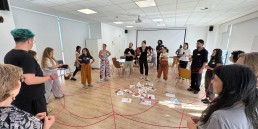
Opvarmningsaktiviteter bygger derefter videre på dette ved at forberede sindet, kroppen og følelserne på kreativ udforskning, ved at vælge aktiviteter, der er forbundet med hovedaktiviteten, enten ved at bruge en lignende metode eller ved at lægge grunden for hovedaktiviteten. De kan give gruppen energi eller berolige den, hjælpe med at fokusere opmærksomheden, aktivere sanserne og fantasien og skabe en fælles rytme, hvor deltagerne føler sig trygge og åbne over for at deltage i hovedaktiviteten med nysgerrighed.
For unge mennesker med færre muligheder, især dem der kan have oplevet udelukkelse, isolation eller afbrudt læring, er disse små øjeblikke af forbindelse særligt værdifulde. At vælge de rette aktiviteter betyder at være følsom over for forskellige evner, kulturelle baggrunde og komfortniveauer. Når det gøres godt, hjælper disse tidlige øjeblikke de unge mennesker med at føle sig velkomne, inkluderede og klar til at arbejde sammen.

Valg af de rette icebreakers og opvarmningsaktiviteter
Når du vælger eller udformer icebreaker- og opvarmningsaktiviteter til unge mennesker med færre muligheder, især dem med handicap, med migrant- og flygtningebaggrund eller fra landdistrikter, bør du overveje:
- Tilgængelighed – kan alle deltage uanset deres evner?
- Følelsesmæssig tryghed – kommer aktiviteten pludselig ind på personlig deling, eller tager den deltagerne ud af deres komfortzone for hurtigt?
- Relevans – forbereder den gruppen på jeres hovedaktivitet, og er den på nogen måde forbundet med dans, musik, billedkunst eller teater? Prøv altid at vælge aktiviteter, der allerede bruger de kunstneriske metoder, men på en enklere måde, for gradvist at introducere deltagerne til metoderne.
- Energiniveau – hav in mente, hvor energiske eller rolige deltagerne skal være til hovedaktiviteten – har I brug for at aktivere gruppen eller hjælpe dem med at blive mere fokuserede?
- Kulturel sensitivitet – er instruktionerne klare, inkluderende og fri for kulturelle antagelser?
Kan alle deltage uanset deres evner, energiniveau, kommunikationsstil eller kulturelle baggrund?
En aktivitet betragtes som tilgængelig, hvis alle kan deltage uden at føle sig presset, udelukket eller udpeget. Dette gælder især for unge mennesker med handicap, neurodivergente deltagere, dem med begrænset mobilitet, eller dem, der føler sig generte i nye grupper.
Vælg aktiviteter, der:
- bruger forskellige måder at deltage på (bevægelse, observation, tegning, tale, brug af gestik)
- ikke kræver avancerede fysiske færdigheder eller kompleks koordination
- ikke forårsager sensorisk overbelastning
- er enkle og nemme at gå ind i
Kommer aktiviteten pludselig ind på personlig deling, eller tager den deltagerne ud af deres komfortzone for hurtigt?
Aktiviteter, der stiller deltagerne i rampelyset fra begyndelsen, får dem til at dele personlige detaljer eller informationer for tidligt, eller får dem til at optræde foran de andre, får deltagerne til at føle sig utrygge og stressede, især dem fra sårbare grupper. Følelsesmæssigt trygge aktiviteter bør ikke presse deltagerne ud af deres komfortzone, før tilliden er etableret.
Vælg aktiviteter, der:
- Er enkle og involverer lavpres-handlinger (bevægelse, lyde, tegning)
- Er legende og ikke indebærer deling af personlige oplysninger
- Er gruppebaserede frem for individuelle, hvor én deltager optræder foran de andre
Et af de vigtigste aspekter, når man vælger en isbryderaktivitet eller opvarmningsaktivitet, er flow og forbindelse til hovedaktiviteten. Opvarmninger bør føles som en naturlig bro fra en lille, enkel aktivitet med lav intensitet til hovedaktiviteten.
For eksempel:
- Før en bevægelses- eller danseaktivitet, vælg en opvarmningsaktivitet, der langsomt aktiverer kroppen og forbereder den på mere intens bevægelse
- Før teateraktivitet, inkludér tilstedeværelse, fokus, fantasilege, stemmeøvelser eller simple gruppebevægelser
- Før billedkunstaktivitet, brug noget fra samme område til at varme fantasien, hænderne og sanserne op
Hvordan skal jeres gruppeenergi være for hovedaktiviteten – aktiveret, rolig, jordet eller forbundet?
De unge ankommer til aktiviteterne/workshoppene med forskellige energiniveauer, påvirket af forskellige faktorer – de kan være trætte, overvældede, distraherede eller rastløse og nervøse. At vælge den rigtige isbryder- og opvarmningsaktivitet kan hjælpe dem med at komme til stede i nuet og forener gruppens energi.
- Brug energigivende aktiviteter, når gruppen virker stille, genert eller uforbundet.
- Brug beroligende aktiviteter, når gruppen virker overstimuleret eller anspændt.
- Brug jordende aktiviteter til at hjælpe deltagerne med at ankomme i rummet, især efter rejse eller lange dage.
- Brug forbindende aktiviteter, når du fornemmer, at folk endnu ikke føler sig trygge ved hinanden.
Nogle deltagere kan have forskellige kulturelle baggrunde, tale forskellige sprog, have forskellige kommunikationsnormer, og det, vi måske finder normalt, kan for dem være et komplet no-go, så du skal være opmærksom på alle disse aspekter.
Vælg aktiviteter, der:
- undgår kulturelt specifikke jokes, talemåder eller referencer
- bygger på universelle former for deltagelse (bevægelse, farve, rytme, lyd, fantasi)
- bruger enkle og visuelt understøttede instruktioner
- ikke kræver forudgående kendskab til lokale sange, traditioner eller kunstformer
Bevægelses- og teaterbaserede introduktionsaktiviteter (navnelege, isbrydere, energigivere, opvarmninger)
The participants stand in a circle and are asked to say their name and to make a movement or physical gesture (e.g., a jump, a wave, a bow, a clap). The entire group repeats the name and the gesture in unison, “mirroring” each participant. Additionally, in the next round each person can repeat all the previous people’s names and movements, until a full circle is made. This activity moves the introduction from a rational, mental process into a physical, “embodied” one, which aids creative flow later on.
Participants stand in a comfortable circle. The facilitator explains that by saying our names, we are “signing” an invisible contract to be present and supportive of one another. One by one, participants (optional: while stepping into the centre) say their name clearly using a specific vocal tone (whispering, shouting, singing, or a deep bass). The entire group repeats the name back to the participant using the same tone and energy. This serves as an “embodied” welcome that uses the voice to break the ice and establish a collective presence.
Participants sit in a circle with one person in the middle. The person in the center says, “The wind is blowing for everyone who…” followed by a statement—for example, “…is wearing black shoes” or “…has blue eyes.” Everyone to whom the statement applies must quickly move and find a new spot in the circle. One spot will always be left open, and the last person to find a place takes the center and makes the next statement. This activity helps participants loosen up, get moving, and learn something small about each other.
A volunteer exits the room. The group decides on a leader that has to make some movements or even dance on the music played by the facilitator, while the rest of the group has to follow her/him. The volunteer enters the room and has to guess who the leader is. This is repeated for another 1-2 rounds.
The participants sit in a circle (on chairs or on the floor), and each says their name (if they don’t know each other) and say how they feel from the perspective of their body – is something painful or sore, does the body feel relaxed, stiff or tired, is there any past injury…). After this check-in, the facilitator invites participants to “give their body what it needs”—whether that’s a gentle stretch, a self-massage, or another small movement. This can naturally transition into a brief warm-up session, led by the facilitator and optionally enriched by movements suggested by participants who feel comfortable sharing.
The participants walk freely around the room and the facilitator gives different prompts: try to fill the empty spaces in the room…walk faster/slower (change walking pace on a scale to 1 to 10, )…walk as if you’re on the moon…you’re late for work…the floor is on fire…you are freezing, etc.
You can add a short awareness exercise by stopping the group and asking them to close their eyes. Then, ask them to point in the direction of specific objects in the room, such as “Where are the yellow curtains?”, “Point to the computer,” or “Where is the red table?”
Participants stand in a circle. One person begins by attempting to move to someone else’s spot, but first they must receive non-verbal consent from that person. This can be done through eye contact, a subtle nod, or any silent gesture of approval. If the chosen person does not give consent, the participant must try with someone else. Once a person gives their spot, they become the next to ask for non-verbal consent and move to another position. If consent was not given, the participant continues to seek it from others. This activity emphasizes respect for personal boundaries, attentiveness, and communication without words.
The participants make a line forming the alphabet depending on the first letter of their name, standing from A to Z, without talking to each other. The facilitator checks from the beginning of the line if the alphabet is lined up properly – each participant says their name out loud and makes a move stepping out from the line so everyone can see it. The others then repeat the name and move. Alternatively, if participants already know each other’s names, the line can be formed based on the birthday date during the year (January-December).
Then, the facilitator asks the participants to face in the same direction. The participant at the end of the line facing towards others must come up with a move and show it to only the person next to him/her, by inviting them to turn around to them and see. This person then shows the same move to the next one and so on, until the last person in the line. Like the broken telephone game, at the end the last person shows the move to the whole group and then the first person shows the original move. Comparing the moves often creates funny situations. This can be repeated in the other direction.
For this activity, a red ball of yarn/wool is needed. Participants stand in a circle. The first person to hold the end of the yarn says their name and a “visible quality” they possess or observe in the group. Holding their piece of the yarn, they toss the ball to someone across the circle, and so on with all the participants until a complex physical web connects everyone in the room. This exercise highlights points of connection and the “collective” nature of the group, making the group qualities more visible.
To physically represent the “objective qualities” and diversity of the group, participants form “human maps” positioning themselves in the room. The facilitator defines the room as a physical map (e.g., North, South, East, West or a scale of 1 to 10) and then gives different tasks (e.g., “Position yourselves based on where you were born” or “How far did you travel to get here?”). Participants move to the spot on the “map” that represents their answer. This allows the group to see their collective composition—where they overlap and where they differ—in a purely visual and physical way.
The participants form a line facing the same direction. The first person in the line is the “locomotive” and dictates the speed of the train, its direction and adds up different movements that the others in the train have to follow. After some time, this person goes back in the line and the next one becomes the leader of the moving train.
One participant walks around a circle of pairs, asking each pair “Do you understand the game?” Each pair redirects them while simultaneously swapping places with others across the circle. The walker may claim any empty spot, and whoever is left without a place becomes the new walker. The facilitator later introduces the command “Chaos!”, at which point all participants scramble to find new partners as if escaping a sudden disaster. The final round is performed in slow motion. The exercise develops adaptability, group awareness, and the capacity to embrace rapid change.
Working in pairs, one person acts as the mover and the other as a silent witness. The mover begins in a fully enfolded posture, slowly unfurls the spine, allows the head to rise, and opens the arms wide before returning to the original position. This cycle is repeated several times. Originating in dance and physical theatre, the exercise emphasises embodied presence, body awareness, and the cyclical nature of growth. Roles are then reversed.
The facilitator announces each hour of the day in sequence through the full 24-hour cycle. Participants mime their typical activities at each announced time and are invited to notice when activities feel energising or depleting, and when they foster openness or withdrawal. Adapted from Theatre of the Oppressed, the exercise promotes reflection on daily routines and embodied habits. It works well as a gentle energiser or as an opening reflection exercise.
In pairs, one participant holds their palm a few centimetres from their partner’s face. The partner must keep their face at the same distance from the palm at all times, following wherever it moves — up, down, sideways, close to the floor, high in the air — without being touched. The leader moves slowly at first, then with more complexity. After 5 minutes, roles are reversed. Developed by Augusto Boal as a foundational Theatre of the Oppressed exercise, Colombian Hypnosis builds body awareness, trust, non-verbal communication, and focused attention. Works well before Image Theatre or any exercise involving physical presence.
Two participants shake hands and freeze in a random position. One steps away. A new participant joins, physically positioning themselves in relation to the remaining person to “complete” a new image — giving it a new meaning, relationship, or context. That person then freezes, and the cycle continues: one steps away, one joins. The exercise should move quickly, with no time for over-thinking. Adapted from Boal’s Image Theatre, Complete the Image develops spontaneity, spatial awareness, and the ability to read and re-read body language. It is an excellent gateway exercise before a full Image Theatre session.
One participant steps into the centre of the space and begins a simple, rhythmic repetitive movement and sound. One by one, other participants connect to the machine — attaching themselves physically or staying close — adding their own repetitive movement and sound that interacts with or responds to what is already there. The facilitator can then ask the machine to speed up, slow down, overheat, or break down. In a second round, the group builds a machine representing a concept (e.g. exclusion, community, power). Originating in Boal’s work, The Machine builds group cohesion, rhythm, creativity, and collective awareness. It works as both a warm-up and a reflection tool when themed around a topic.
Participants walk freely around the space. At any moment, anyone can call out a suggestion starting with “Let’s…” (e.g. “Let’s be astronauts!”, “Let’s swim through honey!”, “Let’s celebrate!”). The whole group immediately responds “Yes, let’s!” and acts it out together for 20–30 seconds before someone else offers a new suggestion. The facilitator participates fully to model enthusiasm and set the energy level. Based on Viola Spolin’s improvisation games, Yes, Let’s! builds spontaneity, group energy, and the “Yes, And” mindset that underpins collaborative creative work. Ideal as an opening energiser or between heavier exercises.
Participants walk around the space on a status scale of 1 to 10: at 1, they move with maximum submission — eyes down, collapsed posture, tentative steps, yielding to everyone; at 10, they move with maximum dominance — upright, expansive, owning the space, never yielding. The facilitator calls out different numbers and participants adjust their body, gaze, pace, and use of space accordingly. In a second phase, participants choose a number and interact briefly with others — noticing how status affects every micro-interaction. Developed from Keith Johnstone’s work on status in improvisation, this exercise reveals how power and hierarchy are communicated through the body. It works as both a physical warm-up and a conceptual introduction to discussions on power, inclusion, and relational dynamics.
Participants stand in a circle and pass energy using the words “Zip,” “Zap,” and “Zop” in sequence. Each person makes eye contact, claps toward another participant, and sends the energy forward. The rhythm should gradually increase, encouraging focus and quick reactions. This activity builds concentration, group awareness, and connection through shared rhythm.
Participants work in pairs, facing each other. One person begins to move slowly while the other mirrors their movements as precisely as possible. After a while, roles can switch or the pair can try to move together without a clear leader. Adapted from physical theatre practices, this exercise develops concentration, trust, and non-verbal communication.
Participants stand in a circle and pass an imaginary ball from one to another. Each time the ball is passed, its qualities can change (size, weight, temperature), and the receiver must respond accordingly. The game should flow continuously, encouraging creativity and responsiveness. This exercise supports imagination, adaptability, and group interaction.
Participants stand in a circle and follow a rhythm while passing a “bunny” using specific sounds and gestures. The pace gradually increases, requiring coordination, attention, and quick reactions. This fast-paced game raises energy levels and strengthens group cohesion, making it a strong closing activity for the warm-up.
Participants begin by gently stretching their bodies and shaking out any tension. They are invited to explore how they move in the space—walking at different speeds, changing levels (high/low), and becoming aware of their posture and presence. The facilitator can guide them with simple prompts (e.g. “take more space,” “move slower,” “notice your breathing”). This exercise helps participants connect with their bodies, release tension, and become more present and aware in the space.
Participants work in pairs. One person is blindfolded, while the other gently guides them through the space using only touch (e.g. holding a hand or guiding from the shoulders). The guide is responsible for the safety and comfort of their partner. After a few minutes, participants switch roles. At the end, invite a short reflection on how it felt to trust, to guide, and to let go of control. This exercise builds trust, sensitivity, and non-verbal communication.
Participants spread out in the space. The facilitator calls out different emotions (e.g. joy, fear, anger, hope, confusion, power), and participants immediately freeze their bodies to represent that emotion, like a statue. Encourage them to use their whole body, facial expression, and posture. The facilitator can invite the group to observe each other or briefly discuss what they see. This exercise develops body expression, imagination, and emotional awareness.
Participants explore how shadows are created using their hands and bodies. They stand in front of a light source and experiment freely, observing how their movements affect the shapes on the screen or wall. The facilitator can guide them to notice how distance, angle, and position change the shadow. This activity helps participants understand the basic principles of shadow formation.
Participants experiment with making their shadows bigger or smaller by moving closer to or farther from the light source. They can compare results and play with exaggeration. The facilitator can invite them to create “giant” or “tiny” shadows. This exercise builds awareness of space, perspective, and visual impact.
One participant creates a shadow shape using their hands or body, while the others try to guess what it represents. The shapes can be abstract or more figurative (animals, objects, characters). Encourage creativity and multiple interpretations. This activity develops imagination, observation, and symbolic thinking.
Participants work as a group to create moving shadow compositions. They can use their bodies to form shapes, transitions, or simple sequences together. The focus is on collaboration and flow rather than choreography. This exercise encourages group awareness, creativity, and non-verbal expression.
INTRODUCTION
MODULE 1
MODULE 2
MODULE 3
MODULE 4

Kontakt
Iuliana Adriana PAVEL (projektleder)
iuliana.pavel@a4action.ro
A4ACTION – Antim Ivireanu Kulturhus, Aleea Islaz, Ghermănești, Snagov, Ilfov, Rumænien, 077170
Medfinansieret af Den Europæiske Union. De synspunkter og holdninger, der kommer til udtryk, er dog alene forfatterens/forfatternes og afspejler ikke nødvendigvis Den Europæiske Unions eller ANPCDEFP’s synspunkter. Hverken Den Europæiske Union eller ANPCDEFP kan holdes ansvarlige for dem.
Projektet gennemføres af følgende organisationer: A4ACTION (Rumænien) – koordinator, Udruga Delta (Kroatien), InterAktion (Østrig), Asociación Espacio Rojo (Spanien) og GAIA Museum Outsider Art (Danmark).


