
MODULE 4
Theatre methods

Guidelines and examples of activities using theatre methods
Using theatre methods in youth work requires careful preparation and flexibility. The facilitator’s main goal is to design sessions that are inclusive, engaging, and safe for all participants. Theatre can be transformative, but only when it values process over performance and encourages reflection rather than evaluation.
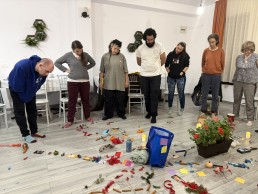
Guidelines for effective facilitation
1.
Build a safe and brave environment
Before starting any activity, create a space where participants feel safe to be vulnerable and brave enough to take creative risks. Working with voice, body, and theatrical expression can bring up insecurities, so establish group agreements about listening, inclusion, and mutual support. Remind participants that there is no right or wrong – the exercise is about exploring together, not competing or achieving perfection. Every voice and body is unique and beautiful. Being “untrained” is not a limitation; it allows for more authentic connection to natural creativity. A brave space acknowledges discomfort but encourages participants to step forward, knowing they will be respected and supported.
2.
Focus on learning and reflection
The value of theatre lies in what participants learn and feel, not in the final product. Encourage them to think about what the experience meant and how it connects to real life. Short reflection moments at the end of each session can be very effective.
3.
Encourage collaboration
Theatre is a shared process. Group exercises, dialogue, and cooperation should always be central. Collective creation helps build empathy and strengthens social bonds.
4.
Adapt to the group
Every group is different. Adjust the pace, language, and intensity of activities according to the participants’ age, energy, and needs. Flexibility ensures equal access for everyone.
5.
Connect with real-life issues
Choose themes that feel relevant and meaningful to participants, such as friendship, inclusion, respect, or community, or facilitate the group to choose a topic they mostly relate to. When the topic resonates, learning becomes more personal and long-lasting.
Theatre, when used thoughtfully, creates a learning space that blends imagination with understanding. It helps participants experience cooperation, empathy, and respect—not as abstract values, but as lived experiences.
Theatre activities








Contact
Iuliana Adriana PAVEL (project manager)
iuliana.pavel@a4action.ro
A4ACTION – Antim Ivireanu Culture House, Islaz Alley, Ghermănești, Snagov, Ilfov District, Romania, 077170
Co-funded by the European Union. Views and opinions expressed are however those of the author(s) only and do not necessarily reflect those of the European Union or the ANPCDEFP. Neither the European Union nor the ANPCDEFP can be held responsible for them.
The project is conducted by the following organisations: A4ACTION (Romania) – coordinator, Udruga Delta (Croatia), InterAktion (Austria), Asociación Espacio Rojo (Spain) and GAIA Museum Outsider Art (Denmark).


