
MODULE 4
Theatre methods

How and which Theatre Methods can be used with YPWFO
Theatre techniques should put more emphasis on involvement, creativity, and emotional safety than on artistic performance when dealing with young people with fewer opportunities (YPWFO). The goal is to establish a secure environment where people may connect with one another, explore, and express themselves in ways that are relevant to them.

YPWFO may have obstacles because of their social or cultural background, education, language, or different abilities. Through encouraging cooperation, understanding, and nonverbal communication, theatre helps overcome difficulties. Participants can learn about their abilities, establish trust, and boost their self-esteem via collaborative storytelling and creating.
According to Nicholson, H. (2005) in Applied Drama: The Gift of Theatre, applied drama indicates that practical theatre gives participants a say in their growth. They are urged to think, try, and create meaning together. For YPWFO, this participatory aspect is particularly potent since it strengthens the group’s sense of equality and belonging.

Creating Emotional Safety
For theatrical work with YPWFO to be effective, emotional safety is essential. It refers to establishing a setting in which people feel safe enough to express themselves, take artistic chances, and experiment with various personas without worrying about criticism or mockery. [15] To create this safe space, you need:
- Group agreements (such as respect for all voices, confidentiality, right to pass, and no judgement) were created cooperatively at the beginning.
- Warm-up exercises and getting-to-know-each-other activities that are appropriate and let participants feel at ease with their voices, bodies, and the group
- Unambiguous rules and regulations that foster mutual respect and understanding
- A nurturing environment that promotes taking innovative chances
- Facilitators who foster a culture of trust by modelling vulnerability (for example, the facilitator sharing that they feel nervous, talking about a mistake they made, saying they are still learning, or being the first to try a slightly awkward exercise)
When properly cultivated, theatre offers a secure, welcoming, and encouraging environment for individuals of all ages and abilities to explore their feelings and grow in confidence [16].
Applied Theatre
Applied theatre is an umbrella term encompassing various practices that use theatre for social, educational, or therapeutic purposes, while acknowledging that traditional theatre, too, can educate, provoke, and foster empathy. It focuses on using drama and performance techniques to address social issues, with work taking place in non-traditional spaces like schools, community centers, and streets. Instead of producing polished performances, applied theatre frequently combines trained facilitators with untrained participants to spark discussion and explore possible solutions to issues. [17]
Theatre in Education (TIE)
Originating in Britain in 1965, Theatre in Education (TIE) uses theatre specifically for educational purposes. TIE usually consists of professional actor-educators performing interactive, child-centred performances for school audiences, with sessions lasting 30 to 60 minutes and tailored to specific age groups. [18] Productions frequently address curriculum topics, moral dilemmas, or contemporary social issues and include audience participation through role-play, debate, and workshops. TIE places a strong emphasis on integrating performance with specific learning goals.
Process Drama
Process drama is a teaching and learning approach in which the facilitator and students alternate roles. Process drama, which was mainly created by Dorothy Heathcote, Gavin Bolton, and Cecily O’Neill, employs unscripted play to investigate issues, circumstances, or ideas. [19]. There is no external audience, and a polished performance is not the goal; instead, players cooperatively create an imaginative environment to analyse challenges and explore diverse perspectives. To generate effective learning experiences, the facilitator manages tension and depth while simultaneously guiding the dramatic investigation [20].
Theatre of the Oppressed (TO)
Augusto Boal’s Theatre of the Oppressed (TO) employs theatre as a tool to promote social and political change. The audience takes on the role of “spectators” in TO, exploring, showcasing, analysing, and transforming the reality they live in. Key techniques include Forum Theatre, where audiences propose and enact solutions to problems; Image Theatre, which creates and transforms tableaux of oppression; and Invisible Theatre, which performs in public spaces to elicit reactions. According to TO, theatre serves as a practice for social change and real-world action.
Each strategy is unique, but all of them share the following characteristics:
- Encourage creativity and self-expression.
- Prioritise the process over the end result.
- Place a strong emphasis on cooperation and involvement.
- Promote introspection and critical thinking.
- The guidelines are flexible enough to accommodate various situations and participant requirements.
Rules for Theatre Use with YPWFO
Start with easy-to-do tasks that progressively boost confidence.
- Instead of using a written performance, use storytelling, improvisation, and games.
- Permit participants to offer suggestions and influence the course of the activity.
- Work with themes like community, friendship, respect, and inclusiveness that speak to the experiences of the participants.
- After activities, provide time for conversation and introspection.
- Honour participants’ rights to observe rather than take part, as well as their boundaries.
- Use nonverbal cues (sound, gesture, and movement) in addition to spoken language.
- Establish trust in the group by providing regular facilitation and encouraging interactions.
When used carefully, theatre may create a learning environment that combines comprehension and imagination. It assists participants in experiencing respect, empathy, and cooperation as lived experiences rather than as impersonal ideals.
References:
[15] The Drama Teacher. (2024). Social Emotional Learning in Drama. Retrieved from https://thedramateacher.com/social-emotional-learning-in-drama/
[16] Educational Theatre Association. (2024). Drama in Education: The Impact of Theatre on Student Success. Retrieved from https://schooltheatre.org/drama-in-education-the-impact-of-theatre-on-student-success/
[17] Humanities LibreTexts. (2023). Applied Theatre. Retrieved from https://human.libretexts.org/Bookshelves/Theater_and_Film/Theatre_Appreciation_(Pipino)/03:_The_Culture_of_Theatre/3.03:_Applied_Theatre
[18] We Are Gibber. (2020). What is Theatre in Education and How It Supports Education. Retrieved from https://www.wearegibber.com/blog/what-is-theatre-in-education/
[19] Kennedy Center. Process Drama: Taking a Walk in Someone Else’s Shoes. Retrieved from https://www.kennedy-center.org/education/resources-for-educators/classroom-resources/articles-and-how-tos/articles/educators/theater/process-drama-taking-a-walk-in-someone-elses-shoes/
[20] PETAA. Defining Process Drama. Retrieved from https://petaa.edu.au/litportal/litportal/Resources-for-Curriculum/Curriculum-Literacies/The-Arts-Drama/defining_process_drama.aspx
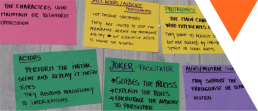
Theatre activities








Contact
Iuliana Adriana PAVEL (project manager)
iuliana.pavel@a4action.ro
A4ACTION – Antim Ivireanu Culture House, Islaz Alley, Ghermănești, Snagov, Ilfov District, Romania, 077170
Co-funded by the European Union. Views and opinions expressed are however those of the author(s) only and do not necessarily reflect those of the European Union or the ANPCDEFP. Neither the European Union nor the ANPCDEFP can be held responsible for them.
The project is conducted by the following organisations: A4ACTION (Romania) – coordinator, Udruga Delta (Croatia), InterAktion (Austria), Asociación Espacio Rojo (Spain) and GAIA Museum Outsider Art (Denmark).


