
Labyrinth Theatre
Each participant walks alone (or in very small groups) through a sequence of transformed spaces (indoors or outdoors) where they encounter actors, objects, and carefully arranged sensory stimuli. The performance happens through personal experience rather than from a stage, making every participant the protagonist of their own journey.


THEME
Sensory exploration, self-reflection, initiation, perception, and personal meaning-making through immersive theatre.

COMPLEXITY
Advanced

GROUP SIZE
10-25 participants + audience

AGE
16+

TIME
90-120 minutes, but can be done also as a big event on more days
Objectives
- To shift participants out of everyday perception and routine thinking
- To stimulate deep sensory awareness and embodied experience
- To encourage personal storytelling and inner reflection
- To explore themes of identity, trust, choice, and transformation
- To create meaningful, individual learning experiences beyond verbal explanation
Materials
- Non-theatrical spaces (rooms, corridors, forests, outdoor paths)
- Basic scenography and symbolic objects
- Blindfolds, fabrics, textured materials
- Lighting sources (dim lights, candles, LEDs)
- Sound elements (voices, ambient sounds, music)
Overview
The Labyrinth Theatre is an interactive, site-specific, and context-orientated form of theatre in which each participant experiences the performance individually. Instead of a traditional stage, the performance takes place in non-theatrical spaces (indoors or outdoors), transformed into a fixed route or itinerary. Participants move one by one, or in tiny groups, through a sequence of spaces and encounters, engaging directly with actors, objects, and sensory stimuli.
Sensory Labyrinth Theatre (SLT) is a specific development of this method, created by Theatr Cynefin (North Wales, UK) and inspired by the work of Colombian theatre director Enrique Vargas in the early 1990s. Over time, the method has been further developed by various organisations across Europe, including BIVEDA and Epsilon III, adapting them to different cultural and educational contexts.
Step-by-Step Instructions:
1. Define the purpose and theme:
Agree on the main theme of the labyrinth (e.g., identity, trust, inclusion, life choices, memory). Choose 1–3 key questions you want participants to carry through the journey.
2. Select the location and map the route:
Choose a non-theatrical space (indoors or outdoors) that can be safely transformed into a fixed route. Map a clear sequence of “meeting points” (stations) and decide the order in which participants will experience them.
3. Design the stations and encounters:
Create short scenes or interactions for each station. Decide what each encounter aims to evoke (emotion, reflection, choice, sensory focus). Keep encounters simple, clear, and consistent with the overall dramaturgy.
4. Plan sensory elements and disorientation tools:
Decide how senses will be filtered (often by limiting vision) and which devices will be used (darkness, blindfolding, sound cues, tactile objects, smell, temperature). Ensure these elements are meaningful and not overwhelming.
5. Create the threshold and waiting area:
Set up a “waiting zone” where participants arrive and detach from everyday reality. Design a strong threshold moment that signals entry into the labyrinth world (e.g., a ritual instruction, a mysterious call, a guided entrance, or a symbolic object).
6. Assign roles and brief the team:
Assign a facilitator to manage timing and participant flow. Assign actors/facilitators to each station and clarify their role, boundaries, and the emotional tone they should hold. Brief the whole team on safety, consent, and how to respond to participant reactions.
7. Prepare scenography, props, sound, and lighting:
Set up each station using minimal but intentional materials. Test lighting and sound levels to ensure a coherent atmosphere and safe movement. Use symbolic objects that invite interpretation rather than explain meaning directly (for example, a rope can represent restriction or connection, a mirror can suggest self-reflection, a chair can become a place of waiting or authority, or a piece of fabric can create a sense of protection or transition).
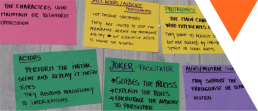
It can also be helpful to include a few concrete elements to guide the experience. For example, a role can be built through a simple action, a short line, a repeated movement, or a small interaction with the participant.
You can also explore different ways of engaging the senses, such as limiting sight (e.g. using a blindfold) or working with touch, sound, or smell, depending on the atmosphere you want to create.
8. Run a full test walk-through:
Do at least one complete rehearsal with the team. Check timing, transitions, clarity of instructions, and the emotional intensity of each station. Please address any safety concerns, such as obstacles, slippery floors, or unclear directions.
9. Brief audience before entry:
Explain the process in simple terms. Emphasise consent, confidentiality, and the right to pause or stop at any time. Ask about allergies, mobility needs, sensory sensitivities, or anything that could affect safety.
10. Begin the journey (one-by-one entry of the audience):
Send participants (members of the audience) into the labyrinth individually (or in tiny groups), usually every 5–10 minutes. Keep the flow steady so participants do not meet each other inside.
11. Maintain flow and emotional safety during the experience:
The flow facilitator monitors time and spacing. Station actors adapt to each participant while staying within agreed boundaries. Keep one person available as emotional support in case a participant needs to pause or exit.
12. Close the experience and transition out:
Provide a clear ending station or exit ritual that helps participants return to normal reality. Offer water, a quiet space, and time to settle before group discussion.
13. Facilitate debriefing and reflection:
Hold a structured reflection using open questions. Offer different ways to reflect: talking, writing, drawing, and silent reflection. Encourage participants to share only what they feel comfortable with.
14. Collect feedback and document learning:
Gather short written feedback or a quick evaluation round. Document observations from facilitators and actors (what worked, what was challenging, and what should be adjusted next time).

Debriefing and Evaluation:Reflection is essential and should take place after the experience, individually or in a group. Participants may share verbally, write, draw, or remain silent. Guiding questions include:
- What stayed with you after the journey?
- What did you feel during the experience?
- Did any moment reflect something from your own life?
Evaluation focuses on depth of engagement, emotional awareness, and the ability to connect the experience to personal meaning rather than on verbal output.
Tips for Facilitators:Prepare the labyrinth carefully and test the flow in advance. Clearly explain the process and participants’ right to stop at any time. Maintain a safe, calm atmosphere. Actors should remain flexible and responsive rather than follow a fixed script. Ensure emotional support is available throughout and after the experience.

Variations:
- Indoor or outdoor labyrinths
- More theatrical or more sensory-focused formats
- Use of audio guidance instead of live actors
- Adaptation for museums, cultural heritage sites, or educational spaces
- Shorter versions with fewer stations and one central theme

Disclaimer:Labyrinth Theatre may provoke strong emotional responses. Participation must be voluntary. Avoid triggering content without proper preparation and support. Respect personal boundaries, confidentiality, and emotional safety at all times.
Theatre activities








Contact
Iuliana Adriana PAVEL (project manager)
iuliana.pavel@a4action.ro
A4ACTION – Antim Ivireanu Culture House, Islaz Alley, Ghermănești, Snagov, Ilfov District, Romania, 077170
Co-funded by the European Union. Views and opinions expressed are however those of the author(s) only and do not necessarily reflect those of the European Union or the ANPCDEFP. Neither the European Union nor the ANPCDEFP can be held responsible for them.
The project is conducted by the following organisations: A4ACTION (Romania) – coordinator, Udruga Delta (Croatia), InterAktion (Austria), Asociación Espacio Rojo (Spain) and GAIA Museum Outsider Art (Denmark).


