
The Trash Art Garden
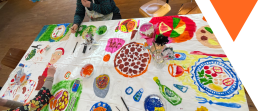
In The Trash Art Garden, participants transform recycled materials into unique sculptures through a playful storytelling experience. The participants co-create an imaginative “garden” where creativity, inclusion, and self-expression flourish. Each participant contributes their own artwork, which in the end becomes part of a shared installation. The activity fosters collaboration, celebrates diversity, and encourages reflection on creativity and upcycling in a safe, supportive environment.


THEME
Inclusion, self-expression, co-creation

COMPLEXITY
Beginner

GROUP SIZE
5-15
participants

AGE
13+

TIME
60
minutes
Step-by-Step Instructions:
- Introduction (10 minutes)
- The piece of fabric is on the entire length of the table. It is a beautiful old garden. All the recycled material, pieces and scraps and glue are ready on the table. The friendly toy animal Lisa is sitting in the garden.
- The facilitator begins by setting the scene through storytelling. The words and level of guidance is adjusted to the group’s abilities. The facilitator can use the story of the animal toy Lisa:
- It greets the participants and asks them to sit down around the table and it tells them that this is its garden.
- Everything in the garden has fallen apart and the participants are asked to help out.
- Would you like to help me? (Everyone would love to help)
- You can find the glue and the lost pieces on the table.
- Now we will put the lost pieces together and make new fabulous sculptures.
- Individual creative work (35 min.)
- Everyone starts to work on their own sculpture.
- If needed, you could help the participants in their individual process with inspiration, practical advice etc.
- Listen carefully to the participants while they are working. What do they say about their process?
- Co-creating and completion (15 min.)
- When the participants have made their individual sculpture, the facilitator will say something like “What lovely sculptures we made. Now we will place them in the garden. And the leftover pieces, we didn’t use, we will put in the empty box”.
- Everyone places their sculpture in the garden. Now the friendly toy animal Lisa is going to visit the garden.

Debriefing and Evaluation:
The toy animal Lisa facilitates the debriefing process. Lisa asks the participants questions like:
- “What did you think of when you made this sculpture?”,
- “How was it to make the sculpture?”,
- “How was it to create with other people?”.
Make sure that Lisa examines all the sculptures and includes the participants in the conversation on the way around the garden. Maybe there are artists who want to show Lisa their sculpture themselves.
If you find it appropriate, include questions about the upcycling aspect of the workshop:
- “How do you see this now, that was trash just before?”
- “What can we bring into other aspects of our lives?
Tips for Facilitators:
- Talk positively about the process. Show your respect for everyone and the collective result.
- Remember there is no right or wrong way to be creative.
The Garbage Art Garden has become a cooperative piece of art. Everyone has contributed and expressed their creativity and artistic way of work, and The Trash Art Garden has become a very special piece of art with a lot of different expressions.

Variations and adjustments:
Can be other settings than a garden – a village, a museum, a festival, a circus, etc. Instead of the toy animal it could be another facilitator that comes to see the garden in the end. It can be anything and have different forms, imagination and personality.

Disclaimer:
- Be aware of choking hazards.
Visual arts activities





Contact
Iuliana Adriana PAVEL (project manager)
iuliana.pavel@a4action.ro
A4ACTION – Antim Ivireanu Culture House, Islaz Alley, Ghermănești, Snagov, Ilfov District, Romania, 077170
Co-funded by the European Union. Views and opinions expressed are however those of the author(s) only and do not necessarily reflect those of the European Union or the ANPCDEFP. Neither the European Union nor the ANPCDEFP can be held responsible for them.
The project is conducted by the following organisations: A4ACTION (Romania) – coordinator, Udruga Delta (Croatia), InterAktion (Austria), Asociación Espacio Rojo (Spain) and GAIA Museum Outsider Art (Denmark).


