
Silent Group Drawing
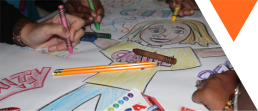
This silent group drawing activity engages participants in non-verbal collaboration and creative expression. Working in small groups, each person contributes to a collective artwork based on shared themes such as “Our ideal community”, “Our home”, or “Our common roots”. Participants take turns adding visual elements and rotating through different sections of the drawing. The process encourages adaptability, mutual understanding, and teamwork, and is followed by a reflection on communication and group dynamics.

THEME
Community building, team building, reconnection, art expression

COMPLEXITY
Beginner

GROUP SIZE
3-15
people (in groups of 3)

AGE
6+

TIME
40
min
Step-by-Step Instructions:
1. Introduction (10-15 min)
- Introduce the participants to the activities and inform them about the rules such as:
- Drawing in silence, no speaking
- Choosing one colour
- Selecting one segment of the paper
2. Split the participants in smaller groups of min 3 and give a flipchart or A2 paper to each group. (20-25 min)
- Participants collaborate on a collective drawing without speaking in groups of 3.
- They work on large flipchart papers divided by 3 themes (1 for each participant), for example: ‘Our ideal community’, ‘Our home’, ‘Our common roots’ (themes can be adapted to suit the group’s context).
- In the beginning, each participant selects one colour and one segment of a paper and begins by adding a single visual element to it.
- After 8-10 minutes, they silently switch places with another group member and add one new element to a different segment. This silent rotation continues until everyone has contributed to each section.
3. Closing (10 min)
- After finishing, the small groups takes a look at their creations and have some minutes to discuss what they see, clarify some details.

Debriefing and Evaluation:
1. Reflection questions – in the same small groups:
- Can you identify similarities among your drawings?
- Do you have similar concepts of the topics (e.g. “Our ideal community”, “Our home”, and “Our common roots”) ?
- Do you think the final result represents your initial idea you started to work on or is it different? How?
2. Then, the whole team gets back together and takes a look at all the drawings together (hang them on the wall or place them on the ground in the middle of a circle where everyone can see them).
3. Evaluation questions – with the whole group:
- What would you share about this experience and your previous discussion?
- Do you think you worked as a team or everyone was doing their own thing?
- Was it comfortable to work in silence?
- What would have been different if you could talk in the meantime?
- What emotion is dominant after this activity?
Tips for Facilitators:
- Observe group dynamics during the drawing phase
- Provide a comfortable setup (large enough paper, space to sit or stand around, good lighting).
- Encourage reflection at the end – being silent during the drawing may bring up interesting emotional or interpersonal reactions.

Variations and adjustments:
- You can try it with verbal communication: allow talking to explore how communication helps or complicates cooperation.
- Evaluation can be done with the usage of visual cards or photos

Disclaimer:
Some participants may feel uncomfortable with silence or not reaching their wished outcome. Make it clear that there’s no “perfect” outcome and ensure a safe space for sharing emotions during the debrief.
Visual arts activities


Contact
Iuliana Adriana PAVEL (project manager)
iuliana.pavel@a4action.ro
A4ACTION – Antim Ivireanu Culture House, Islaz Alley, Ghermănești, Snagov, Ilfov District, Romania, 077170
Co-funded by the European Union. Views and opinions expressed are however those of the author(s) only and do not necessarily reflect those of the European Union or the ANPCDEFP. Neither the European Union nor the ANPCDEFP can be held responsible for them.
The project is conducted by the following organisations: A4ACTION (Romania) – coordinator, Udruga Delta (Croatia), InterAktion (Austria), Asociación Espacio Rojo (Spain) and GAIA Museum Outsider Art (Denmark).


