
Dear Reader,
Welcome to our Inclusionary TOOLBOX with artistic methods for youth workers, social workers or other professionals working with young people with fewer opportunities, especially those from rural areas, with a migrant or refugee background or with disabilities. This is your gateway to a world of engaging activities from different artistic fields such as music, movement, visual arts and theatre, brought closer to youth workers who would like to use creative methods in their work, but don’t have an artistic background.
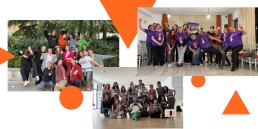
The Inclusionary – Art for Social Inclusion project was implemented under the Erasmus+ Programme of the European Union, within the KA2 Cooperation Partnership in the Youth Field. It brought together five partners from Romania, Croatia, Austria, Spain, and Denmark, combining the expertise of youth organisations and youth workers (A4ACTION, Udruga Delta, InterAktion) with artists and cultural institutions (Espacio Rojo and GAIA Museum). The partnership shared a common goal: to explore, develop, and implement innovative artistic methods to improve the quality of youth work, particularly in supporting the inclusion of young people from disadvantaged backgrounds. Additionally, the project created opportunities for cross-sector collaboration, cultural exchange, and the sharing of knowledge, highlighting the role of art as a powerful tool for inclusion, participation, and self-expression among young people with fewer opportunities. Our collective effort focused on learning, developing, and sharing innovative ways to use art in youth work, particularly to support social inclusion and the integration of young people from rural areas, those with migrant or refugee backgrounds, and those with disabilities. This involved creating and adapting activities specifically tailored to these groups, while ensuring that the methods remain flexible and applicable to a wide range of participants.

It all started with a research conducted in all the partner countries with youth workers, social workers and educators, which highlighted the strong potential of artistic and creative methods in fostering inclusion among young people with fewer opportunities. Data collected from 132 respondents and 29 focus group participants showed that 72.7% of youth workers already use visual arts methods, while many report key challenges such as insufficient financial resources (62.1%), difficulties reaching target groups (41.7%), and a lack of skilled professionals (39.4%). The findings also demonstrate that creative approaches effectively promote self-confidence, self-expression, and a sense of belonging. To strengthen their use, youth workers emphasise the need for increased funding, specialised training, stronger professional networking with other professionals and organisations experienced in inclusive artistic practices, and improved community and policy support, ensuring accessibility, sustainability, and wider impact of inclusive artistic practices. You can read more in our State-of-the-Art report.
Building on these findings and collaborative efforts, as well as testing the activities in international trainings with youth workers and then nationally with young people, this TOOLBOX has been designed as a practical and user-friendly resource that supports professionals in applying artistic methods in inclusive youth work. It offers step-by-step activities that can be used in different contexts with a varied target group, regardless of knowledge or experience with the artistic field, neither from the facilitators nor the youngsters. You won’t need to know how to play an instrument, how to dance or act, or how to use clay or paint. The methods were created to be participative, collaborative, and process-oriented rather than product-driven.
What unites them is not the technique itself, but the way it is used—as a tool for exploration, emancipation, shared creation, and social engagement. (Boal, 2005)

Contact
Iuliana Adriana PAVEL (project manager)
iuliana.pavel@a4action.ro
A4ACTION – Antim Ivireanu Culture House, Islaz Alley, Ghermănești, Snagov, Ilfov District, Romania, 077170
Co-funded by the European Union. Views and opinions expressed are however those of the author(s) only and do not necessarily reflect those of the European Union or the ANPCDEFP. Neither the European Union nor the ANPCDEFP can be held responsible for them.
The project is conducted by the following organisations: A4ACTION (Romania) – coordinator, Udruga Delta (Croatia), InterAktion (Austria), Asociación Espacio Rojo (Spain) and GAIA Museum Outsider Art (Denmark).


