


Forum Theatre — The anti-model in one minute
Forum Theatre is an interactive method in which participants first watch a short scene of oppression or injustice, then step onto the stage as “spect-actors” to replace the protagonist and test alternative ways of responding. Guided by a neutral facilitator (the “Joker”), the group collectively rehearses strategies for change in a safe theatrical space before applying them in real life.

THEME
Social Justice and Conflict Resolution

COMPLEXITY
Intermediate

GROUP SIZE
10-12 participants + audience

AGE
16+ (can be adapted for younger with appropriate scenarios)

TIME
90-120 minutes (core version). For an extended version, allow up to 150 minutes to accommodate deeper reflection.
Objectives
- Enable participants to explore different forms of oppression and practise strategies for change
- Develop critical thinking and problem-solving through theatrical intervention
- Build empathy and understanding of different perspectives
- Empower participants to become active agents of social change
- Practice collective problem-solving in safe theatrical space
Materials
- Open performance space with excellent visibility for the audience
- Chairs arranged in a semicircle for audience
- Optional: simple props, costume pieces, or set elements
- Flipchart or whiteboard for documenting insights and solutions
Overview
Forum Theatre is an interactive form of Theatre of the Oppressed developed by Augusto Boal in 1973 during a literacy project in Peru. Participants watch a short scene depicting oppression or injustice (the “anti-model”), then become “spect-actors” who can stop the action, replace the protagonist, and try alternative solutions. A facilitator called the “Joker” guides the process neutrally, ensuring realistic exploration without imposing solutions. The method was born when Boal realised that audience members wanted to not just suggest solutions but also physically test them onstage.
Step-by-Step Instructions:
0. Group preparation (20–30 mins, before the session begins):
Before the session opens to the full group, the facilitator works with everyone to prepare. Explain Forum Theatre clearly: what the anti-model is, what the Joker does, and what spect-actors are invited to do. Together, identify or confirm a topic based on participants’ real experiences.
A small sub-group (4–6 volunteers) creates and rehearses the anti-model scene with the support of the facilitator, while the rest of the group becomes spect-actors. If the group is larger (10–12 participants), you can divide them into two groups, each creating and performing a different theatre scene.
Allow time for a short rehearsal and a warm-up (choose 2–3 activities from the additional chapter at the end of the Toolbox, depending on the group’s needs). Once everyone understands their role and the scenes are ready, the formal session can begin.
1. Introduction (10 mins):
Welcome the audience (this can include both young people who are not part of the play and members of the wider community) and explain the Forum Theatre concept. Emphasise that they will see a scene where someone faces oppression or injustice. After watching it once, they can intervene by shouting, ‘STOP!’ and stepping on the scene to try different solutions. Please clarify that there are no ‘magic’ solutions, as we are collaboratively exploring realistic possibilities. The Joker facilitates but doesn’t provide answers. This work is about collective wisdom and experimentation.
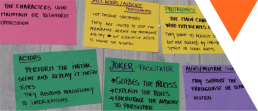
Roles in Forum Theatre
Joker (Facilitator):
The Joker guides the Forum Theatre process. They explain the rules, encourage audience participation, and keep the discussion constructive and respectful. The Joker does not give solutions but helps the group explore possibilities.
Protagonist
The protagonist is the main character who experiences oppression. They want to achieve something but are blocked by individuals, systems, or social norms. The story focuses on their struggle. IMPORTANT NOTE: Spect-actors can substitute this character, but not just change his/her personality or motivation fundamentally.
Oppressor(s):
Oppressors are the characters who maintain or reinforce oppression. They may act intentionally or unconsciously and often represent power structures (authority figures, institutions, social pressure). IMPORTANT NOTE: Spect-actors can’t substitute this character in their interventions.
Actors:
Actors perform the initial scene and replay it multiple times. They respond realistically to interventions, maintaining the logic of the situation rather than making it easy for the spectators to “win” (resolve the conflict/oppression).
Allies/Neutral Characters (optional):
These are characters who may support the protagonist or remain neutral. They help show how systems of oppression and inequality operate in daily life, and invite participants to rehearse possible actions for change in a safe environment. They can get a handle on the situation and become key figures in testing different strategies for change.
Spect-actors, also known as audience participants, are not passive spectators. They are invited to stop the performance, replace the protagonist, and try out alternative actions to change the situation. This practice turns spectators into “spect-actors”.
2. Present the anti-model (20 minutes):
Actors perform a prepared scene showing oppression or injustice. Examples may include workplace discrimination, bullying, family conflict, housing injustice, police harassment, educational barriers, and healthcare discrimination. The scene should end with the oppression unresolved and the protagonist unable to overcome the situation. Keep the scene realistic, relatable to participants’ actual experiences, and approximately 5–7 minutes long.
3. Initial Discussion – Joker’s Facilitation (10 minutes):
The Joker leads the analysis by asking: What happened in the scene? Who was oppressed? Who was the oppressor? What made it difficult for the protagonist to change the situation? What emotions did you observe? What power dynamics were at play? This critical analysis prepares participants for informed interventions.
4. Second presentation with interventions from the audience (40 minutes):
The scene is played again from the beginning. The Joker invites the spect-actors (the audience) to shout “STOP!” at any moment and step into the scene, replacing the protagonist to try a different approach. The Joker should also be ready to make the first “STOP!” if needed, to encourage participation, until the audience feels comfortable to step in and get involved.
Key rules:
- Spect-actors can only replace the oppressed character or the neutral actors, not the oppressor (we can only change ourselves, not force others to change)
- Actors stay in character and provide realistic resistance—no easy victories
- The Joker stops interventions that are ‘magical’ or unrealistic solutions (no Superman swooping in!).
- Multiple participants should try different approaches
- After each intervention (3-5 minutes), briefly discuss: What worked? What didn’t? Why? What might happen next?
- Encourage building on previous interventions

Debriefing and Evaluation:
Reflection Questions:
- What strategies worked best in the interventions? Which didn’t work? Why?
- How did it feel to intervene and be on stage trying to create change?
- What real-life situations does this story relate to?
- What barriers exist to changing the reality we saw?
- What support, resources, or solidarity would people need?
- What surprised you during the interventions?
- How can we take these rehearsals into real life?
- What did this process teach about collective action versus individual heroism?
Evaluation Criteria:
Observe and assess the level of participant engagement and willingness to intervene, the quality and realism of the interventions proposed, the depth of critical reflection on power dynamics, the ability to analyse why certain strategies work or don’t work, confidence growth throughout the session, the group’s capacity to build on each other’s ideas collectively, and understanding of the difference between individual and systemic solutions.
Tips for Facilitators:
- Choose scenarios directly relevant to participants’ lived experiences—authenticity is crucial
- Keep the initial anti-model scene short (5-7 minutes maximum) to maintain energy
- The Joker must remain genuinely neutral—resist the urge to impose your solutions or ideology
- Encourage actors to provide realistic resistance and stay in character, not give in too easily
- Make space for quieter participants—invite them specifically but don’t pressure them.
- If an intervention clearly isn’t working, the Joker can pause and ask the group, “What’s happening here? Why isn’t this strategy working? What’s the obstacle?”
- Document interventions and insights on flipchart for later reference and action planning (see Legislative Theatre in Variations)
- Build psychological safety before starting—participants should know they can choose to observe
- Consider having participants create their own anti-model scenes in subsequent sessions based on their real experiences
- Be prepared for emotional reactions—oppression is real and personal
- Connect Forum Theatre to actual organizing strategies when appropriate

Variations and adjustments:
- Issue-Specific Forum: Dedicate entire session to one specific issue (peer pressure, workplace discrimination, family conflicts, housing rights)
- Community Forum Theatre: Invite broader community members to watch and participate, not just the regular group
- Legislative Theatre: Take the most successful solutions from Forum Theatre to policymakers (see separate Legislative Theatre activity)
- Youth-Created Scenes: After learning the method, participants develop anti-model scenes from their own real experiences
- Multi-Scene Forum: Present several short scenes in one session on related themes, allowing comparison
- Forum Theatre with Professional Actors: Combine trained actors with community participants for more polished presentations
- Rainbow of Forum: Use Forum Theatre to explore not just external oppression but internal conflicts and contradictions

Disclaimer:
Some topics explored in Forum Theatre may trigger difficult emotions or traumatic memories. Establish clear safety agreements at the start of any session. All participants always have the right to observe rather than participate actively. Debrief thoroughly after sessions dealing with sensitive issues like violence, discrimination, or abuse. Be prepared to provide emotional support or referrals to professional help if participants become distressed. Ensure the space is confidential and respectful—what’s shared in Forum Theatre should stay in the room unless participants choose to take action publicly. The Joker/facilitator should have training in facilitation techniques and, ideally, trauma-informed practice. Remember that Forum Theatre can surface real pain and real conflicts—treat participants’ experiences with care and respect.
Theatre activities
Nothing found.

Contact
Iuliana Adriana PAVEL (project manager)
iuliana.pavel@a4action.ro
A4ACTION – Antim Ivireanu Culture House, Islaz Alley, Ghermănești, Snagov, Ilfov District, Romania, 077170
Co-funded by the European Union. Views and opinions expressed are however those of the author(s) only and do not necessarily reflect those of the European Union or the ANPCDEFP. Neither the European Union nor the ANPCDEFP can be held responsible for them.
The project is conducted by the following organisations: A4ACTION (Romania) – coordinator, Udruga Delta (Croatia), InterAktion (Austria), Asociación Espacio Rojo (Spain) and GAIA Museum Outsider Art (Denmark).