


Things to Think of Before You Start - Guidelines for facilitators
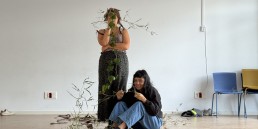
For everyone to feel as much as possible part of the activities, we are aiming to create safe and brave spaces, where the young people feel safe enough to be themselves and brave enough to participate and go out of their comfort zone and express themselves freely without the fear of being judged. There is no right or wrong way of exploring artistic methods. However, for creating such spaces, we, the facilitators, have to carefully prepare the environment and our facilitation approach to fit each group’s needs. Inclusion does not start with the activity itself; it begins with the way we welcome participants, how we communicate, and how we create a space where each person can participate fully, safely, and authentically.
Below, we have focused on the most important aspects you should consider when preparing creative activities with participants with fewer opportunities, especially those with disabilities, a migrant/refugee background or from rural areas.
When working with young people, especially those with fewer opportunities, it is very important that you take care of their physical and emotional safety. Safeguarding involves establishing clear boundaries, maintaining confidentiality, and preventing harm by being alert and responsive to risks. This means creating conditions where young people feel protected, respected, and aware of their rights. (UNICEF, n.d.)
Recommendations:
- Create clear group agreements together with the participants so everyone knows what respectful participation means
- Define clear roles and create a support system
- Inform participants about their rights: to feel safe, step back from an activity if they don’t feel comfortable and only share as much as they feel comfortable with
- Ensuring physical safety in the space and accessibility of routes, materials, and activities
- Being attentive to signs of discomfort, exclusion, or distress
- Provide additional professional psychological support when needed by assigning a person responsible for safeguarding (it is recommended that this person is not part of the organising team)
Using artistic and expressive methods in youth work can bring up a lot of insecurities and feelings of not being good enough, so it is very important to create a safe and brave space where the young people can feel free to express themselves.
What is a safe space?
A space that allows the young people to feel secure physically and emotionally, a space without judgement, exclusion or harm. (Council of Europe, 2020)
But, what is a brave space?
It is a space that invites the young people to step out of their comfort zone, explore, and feel free to experiment, knowing that the group will support them and hold the space for them without judgment.
To create such spaces you should pay attention to:
- Using inclusive language and avoid assumptions about backgrounds, abilities or identities
- Co-create guidelines that define respectful behaviours and confidentiality
- Invite participation without pushing or forcing it (give the option of Opt out)
- Emphasise that there is no right or wrong way of doing creative work and the focus is on the process and not on the final product
- Providing different ways to participate, as much as the method chosen allows – verbally, through writing, visually, through movement or quietly or even digital media – to accommodate different comfort levels and communication styles
Many young people with fewer opportunities may have lived through experiences of migration, displacement, discrimination, marginalisation, loss, violence or other forms of trauma. A trauma‑informed approach means assuming that trauma may be present, even if not visible, however we will not be focusing on the trauma itself, but rather on how to approach it (Valgiusti, 2023):
- Keep in mind that trauma may influence how a young person participates
- Avoid practices or situations that may trigger distress (loud sounds, pressure, competition, themes like violence, war, etc.)
- Offer choices, predictability and emotional reassurance whenever possible
This means:
- Beginning with simple grounding or check-in activities before inviting deeper explorations, which help participants feel present and emotionally prepared
- Keeping the structure of the session clear and consistent
- Avoiding activities that require sharing personal stories unless young people choose to
- Being mindful of physical contact, personal space, and sensory triggers
- Allowing participants to step out of an activity without having to justify themselves
Trauma-informed facilitation allows young people to feel more in control of their participation, which strengthens trust, autonomy, and emotional well-being. (Saferworld et al., 2025)
The activities in this TOOLBOX are created with the process in mind, rather than the final product. They are focusing on self-expression, exploration with different methods, materials and mediums, collaboration and working together as a team and shared experiences.
It is very important that you, as facilitators, emphasise to your groups from the very beginning that the goal is not to make perfect art, but rather to explore and experiment and that there is no right or wrong way of doing it.
This will help the participants relax and enjoy the creative process
The workshop space is an important part of the preparation and delivery of creative workshops and you should pay even more attention to it when you work with young people with fewer opportunities, especially those with disabilities. Whenever possible, choose a place that supports inclusion:
- Make sure the room is physically accessible (ramps, elevators, chairs, door width, accessible toilets)
- Pay attention to overwhelming stimuli such as bright light, loud noise
- Think about movement – is there enough space for the participants to move freely
- Provide a quiet space for those that might need a break or don’t feel comfortable to take part in an activity.
Arranging the space with these things in mind is part of the Universal Design for learning (CAST, 2018), which can help create a warmer and more welcoming atmosphere for diverse participants with different needs.
We designed the activities thinking about accessibility of resources and budget, so most of them are low cost, easy to find or some activities even invite you to use recycled materials. However, working with young people with different needs, you might have to pay attention to some small details:
- Make materials available in multiple formats (large print, tactile, high-contrast colours, easier to break by hand etc.)
- Offer alternatives for participants who cannot use scissors or sharp objects
- Check beforehand if participants have sensory sensitivities (e.g., to textures, sounds, smells)
- Ensure that all materials and tools are accessible to participants with physical, sensory, or cognitive disabilities
- Check in regularly to see if anyone needs assistance or adaptations

Contact
Iuliana Adriana PAVEL (project manager)
iuliana.pavel@a4action.ro
A4ACTION – Antim Ivireanu Culture House, Islaz Alley, Ghermănești, Snagov, Ilfov District, Romania, 077170
Co-funded by the European Union. Views and opinions expressed are however those of the author(s) only and do not necessarily reflect those of the European Union or the ANPCDEFP. Neither the European Union nor the ANPCDEFP can be held responsible for them.
The project is conducted by the following organisations: A4ACTION (Romania) – coordinator, Udruga Delta (Croatia), InterAktion (Austria), Asociación Espacio Rojo (Spain) and GAIA Museum Outsider Art (Denmark).