
MODULE 4
Theatre methods

Introduction to Theatre Methods
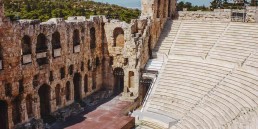
The Origins and Evolution of Theatre
Since ancient times, theatre has been a part of human civilisation. The Greek philosopher Aristotle defined theatre as mimesis, or the imitation or re-presentation of nature, an essential human impulse to explore life through performance. [1] Its origins are thought to lie in religious rituals and communal celebrations, where communities gathered to enact stories, honour deities, and make sense of the world around them. [2]
Theatre has always changed, from the great tragedies and comedies of Ancient Greece to the mystery plays of the Middle Ages. In the 19th and 20th centuries, theatre explored themes of industrialisation, political change, and human psychology, reflecting the social upheavals of the time. [3] Theatre was seen as a mirror of reality, allowing audiences to reflect on the society they lived in. [4] Contemporary theatre continues this evolution, embracing a variety of forms and voices while still being a potent medium for social commentary, cultural expression, and storytelling.
What is Applied Theatre?
Performance is only one aspect of theatre. It stands for a method of education, communication, and human experience exploration. People connect feelings, ideas, and behaviours through theatrical expressions, turning imagination into comprehension. Theatre techniques assist participants in developing empathy, expressing their thoughts, and thinking creatively and emotionally about real-life issues in educational and youth work environments.
Applied theatre, unlike commercial or performance-focused theatre, operates in non-traditional settings and caters to communities—often marginalised or vulnerable groups. [5] Applied theatre uses drama and performance techniques to address issues of social concern, with participants having a vested interest in the topic being explored. [6] Applied theatre, also known as applied drama or applied performance, is an umbrella term for the use of theatrical practices and creativity that engages participants beyond mainstream theatre.
Both traditional and applied theatre share deep roots and many goals. Traditional theatre (from Shakespeare to Brecht to contemporary independent work) can educate, provoke, foster empathy, serve as a communal ritual, and act as a mirror of society. Professional ensembles worldwide have long embraced socially engaged, participatory, and community-oriented approaches. The distinction between the two is therefore one of emphasis and context rather than of purpose. Traditional theatre typically involves trained actors performing scripted works, often in formal venues, with a primary focus on the aesthetic quality of the final performance. Applied theatre, by contrast, engages non-professionals and community members (often from marginalised groups) in a process that is explicitly non-formal, educational or therapeutic, largely unscripted, and oriented towards personal and collective transformation rather than polished performance. It takes place in community centres, schools, prisons, and public spaces rather than theatre venues. As Eric Bentley’s foundational definition puts it: “A impersonates B while C looks on”—and it is precisely this triangular relationship of actor, action, and audience that applied theatre continually disrupts and reimagines. In applied theatre, the “audience” becomes active; the “actors” are community members; and the “performance” is inseparable from the learning process. Applied theatre, specifically focuses on the process of learning and personal growth. [7] Participants are active creators of meaningful interactions, exploring themes that matter to them in a supportive environment.
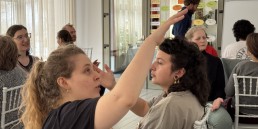
For instance, in role-playing, participants adopt various personas to examine intricate circumstances, such as a dispute at work or among neighbours. They gain fresh insights, hone their communication skills, and cultivate empathy through this embodied experience. In a similar vein, improvisation fosters self-assurance, inventiveness, and quick thinking as participants react to situations without following a script. These methods support young people in learning via action and collective discovery while fostering authentic self-expression.
Theatre of the Oppressed, theatre in education, drama therapy, community theatre, and other diverse practices are all included in the broad category of applied theatre [8]. These methods promote creativity, involvement, and teamwork, making theatre accessible to everyone, irrespective of artistic ability or past experience.
Facilitators frequently note that theatre gives individuals self-assurance and a voice. Once they feel comfortable in the group, even shy or reluctant people tend to express themselves more. This phenomenon explains why theatre is such an effective medium for experiential learning—learning via participation, introspection, and group exploration.

A Note on This Module’s Design: Classic Methods Meet Inclusive Adaptations
Module 4 deliberately combines two complementary strands. On the one hand, it draws on well-established methods of the Theatre of the Oppressed (Forum Theatre, Image Theatre) that have been tested for decades with marginalised communities and that the Inclusionary project re-grounds for the youth-work context. On the other hand, it introduces original and hybrid methods developed within the project, which transfer tools from improvisation, narrative therapy, and somatic practice into non-formal education with YPWFO. Each classic method is presented with adaptations for accessibility and inclusion; each newly designed method is explicitly framed through its innovation angle and, where relevant, through its relevance for YPWFO. The goal is a module that is at once historically grounded and openly innovative, inclusive not only in the groups it serves, but in the range of practices it brings together.
Theoretical Foundations of Applied Theatre
There are strong theoretical foundations to the notion of employing theatre to promote social and educational growth. Several instructors and professionals created cutting-edge techniques during the 20th century that still influence applied theatre today.
Critical Pedagogy and Paulo Freire
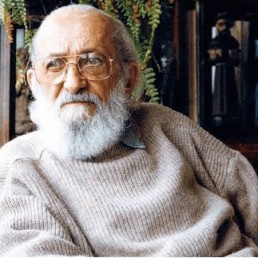
Paulo Freire’s work is the cornerstone of a lot of practical theatre practice. A new approach to education was presented in Freire’s Pedagogy of the Oppressed (1968), which moved the emphasis from passive “banking” education—in which teachers impart knowledge to students—to conversation, empowerment, and praxis—a combination of contemplation and action—for social transformation. [9]
By encouraging participants to become agents of change rather than passive recipients of knowledge, Freire’s radical pedagogy for marginalised communities was founded on the idea of conscientização (critical consciousness), which holds that everyone, regardless of formal education, is capable of looking critically at their world through dialogue with others. [10] This philosophy had a profound impact on applied theatre by addressing social issues like gender inequality and power imbalances through embodied learning and collaborative creation.
Practitioners of Key Theatre
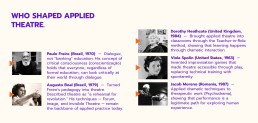
Freire’s work greatly influenced Augusto Boal when he created his work Theatre of the Oppressed (1973). [11] Boal and Freire grew close, with Boal referring to Freire as his “last father” after Freire’s passing. Boal’s method views theatre as a practice for social change, encouraging participants to question reality and imagine alternatives through performance. Applying the Freirean concepts of empowerment and discourse to theatre practice, he named his approach after Freire [12].
Dorothy Heathcote developed the Teacher-in-Role method, wherein facilitators engage participants in constructed scenarios to facilitate learning through dramatic interaction. Her research highlighted how crucial it is to place players in influential roles within the play.
By emphasising spontaneity, playfulness, and conversation, Viola Spolin’s improvisation games make theatre accessible through game-based learning, as opposed to traditional performance instruction [13].
Psychodrama by Jacob Moreno applies dramatic approaches to therapeutic contexts, using performance to investigate human experiences and emotions [14].
These practitioners share fundamental ideas derived from Freirean philosophy, despite the differences in their methods:
- Experience and involvement are the best ways for people to learn.
- Deeper understanding results from cooperation and shared production.
- Social learning requires critical consciousness, empathy, and reflection.
Techniques must be flexible enough to accommodate participants’ demands and circumstances.
These concepts are still fundamental to drama education and practical theatre today. They encourage inclusion, critical thinking, and emotional expression in non-formal contexts like youth employment, assisting participants in gaining social and personal skills.
References:
[1] Roach, J. (1996). Cities of the Dead: Circum-Atlantic Performance. New York: Columbia University Press.
[2] Britannica. Theatre History. Retrieved from https://www.britannica.com/art/theater-building
[3] Britannica. (1998). Theatre – Evolution, Production, Design. Retrieved from https://www.britannica.com/art/theater-building/The-evolution-of-modern-theatrical-production
[4] OpenALG. History of Theatre: 20th Century Modern Theatre. Retrieved from https://alg.manifoldapp.org/read/history-of-theatre-20th-century-modern-theatre
[5] Humanities LibreTexts. (2023). Applied Theatre. Retrieved from https://human.libretexts.org/Bookshelves/Theater_and_Film/Theatre_Appreciation_(Pipino)/03:_The_Culture_of_Theatre/3.03:_Applied_Theatre
[6] Theatre Development Fund. Applied Theatre. Retrieved from https://www.tdf.org/on-stage/theatre-dictionary/search-by-letter/applied-theatre/
[7] Oxford Research Encyclopedia of Education. (2020). Applied Theatre. Oxford University Press.
[8] SUNY Create. (2021). Theatre Appreciation: Applied Theatre Chapter. State University of New York.
[9] ALA Choice. (2020). Augusto Boal and Theatre of the Oppressed. Retrieved from https://ala-choice.libguides.com/c.php?g=988298&p=7149335
[10] Boal, A. (1979). Theatre of the Oppressed. Pluto Press.
[11] ImaginAction. (2023). Theatre of the Oppressed. Retrieved from https://imaginaction.org/media/our-methods/theatre-of-the-oppressed-2/
[12] Heathcote, D. (1984). Collected Writings on Education and Drama. Hutchinson.
[13] Spolin, V. (1963). Improvisation for the Theater. Northwestern University Press.
[14] Moreno, J. L. (1987). Psychodrama. Beacon House.
Theatre activities
Nothing found.

Contact
Iuliana Adriana PAVEL (project manager)
iuliana.pavel@a4action.ro
A4ACTION – Antim Ivireanu Culture House, Islaz Alley, Ghermănești, Snagov, Ilfov District, Romania, 077170
Co-funded by the European Union. Views and opinions expressed are however those of the author(s) only and do not necessarily reflect those of the European Union or the ANPCDEFP. Neither the European Union nor the ANPCDEFP can be held responsible for them.
The project is conducted by the following organisations: A4ACTION (Romania) – coordinator, Udruga Delta (Croatia), InterAktion (Austria), Asociación Espacio Rojo (Spain) and GAIA Museum Outsider Art (Denmark).


