


MODULE 3
Visual arts methods

Introduction to Visual Arts Methods
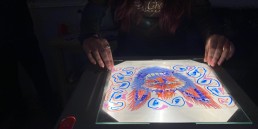

“These [visual arts] are the arts that meet the eye and evoke an emotion through an expression of skill and imagination. They include the most ancient forms, such as painting and drawing, and the arts that were born thanks to the development of technology, like sculpture, printmaking, photography, and installation art.” (Britannica.com)
Visual arts are about expressing yourself through images, materials, and forms. They include many different ways to create–such as drawing, painting, collage, sculpture, photography, digital art, and video. Artists and participants can work with almost any material – clay, wood, stone, paper, plastic, recycled objects, or natural materials, but also digitally. This diversity shows that creativity can emerge from anything and that artistic expression is accessible to everyone, regardless of age, background, or experience.
Art has been part of human life for thousands of years. The oldest known paintings, found in Chauvet Cave, in France, are about 30,000 years old. They were engraved and painted with red ochre and black pigment and depict horses, rhinos, lions, aurochs, mammoths, and humans, often hunting. Even earlier, humans carved simple symbols on stones, showing a natural need to communicate and make meaning through images. These early artworks remind us that making art is a universal human impulse that transcends time and culture.
Visual art can be seen as a language–a way to communicate without words, to share emotions, ideas, and experiences. It can tell stories, build connections between people, and encourage reflection. For youth work, visual art offers a powerful tool for inclusion and self-expression. Through creative activities, young people can explore who they are, develop confidence, and express feelings that might be hard to put into words.
Using visual art methods does not require professional art skills or special talent. The focus is not on creating “perfect” art, but on the process of exploring, expressing, and connecting. Art can help reduce stress, strengthen identity, and build community. Whether through a quick drawing, a collaborative mural, or an experimental digital collage, visual art gives every person a voice.
References:
[1] https://www.britannica.com/browse/Visual-Arts
Visual arts activities





Contact
Iuliana Adriana PAVEL (project manager)
iuliana.pavel@a4action.ro
A4ACTION – Antim Ivireanu Culture House, Islaz Alley, Ghermănești, Snagov, Ilfov District, Romania, 077170
Co-funded by the European Union. Views and opinions expressed are however those of the author(s) only and do not necessarily reflect those of the European Union or the ANPCDEFP. Neither the European Union nor the ANPCDEFP can be held responsible for them.
The project is conducted by the following organisations: A4ACTION (Romania) – coordinator, Udruga Delta (Croatia), InterAktion (Austria), Asociación Espacio Rojo (Spain) and GAIA Museum Outsider Art (Denmark).