


MODULE 3
Visual arts methods

How and which visual arts methods can be used with YPWFO
Using visual art methods in connection with people with special needs or young people with fewer opportunities can be a powerful and valuable way to open the gates to inner strength and empowerment, not necessarily as an art therapy but also as a pure process of creation and sharing with the viewer.
The creative process is not only considered a way of expressing oneself, but as a personal development process. Such a process is the right of every human being, regardless of disability or not. Tacit knowledge or a silent language–a language that, due to inhibition, has difficulty finding words. Through creative processes within visual arts, drama or music, it can be given the opportunity to be expressed. (Henriksen, 1998)
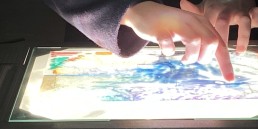
When approached through participatory and collaborative practices, visual arts acquire an additional dimension: they become spaces of dialogue, collective creation, and social inquiry. Inspired by the perspectives of Luis Camnitzer and Claire Bishop, visual arts methods move beyond producing aesthetic objects to fostering autonomy, imagination, and shared reflection, making them especially relevant for working with young people with fewer opportunities. (Bishop, 2012; Camnitzer, 2009; Freire, 1970).
In this context, visual arts practices emphasise the process rather than the product. The creative act is not limited to individual expression but extends to interaction, cooperation, and critical engagement with others and the environment. Camnitzer proposes that art should function as an educational tool that stimulates curiosity, experimentation, and problem-solving rather than reproduction or technical mastery. The focus is on generating learning situations where participants discover their language of expression. (Camnitzer, 2009; Freire, 1970).
Simple and accessible techniques, such as drawing, collage, object-making, or working with found materials, offer open-ended possibilities for creativity. For example, young people can be invited to draw invisible things such as silence, fear, or hope, or to create an imaginary object that solves a problem in their community. These exercises allow participants to explore their imagination and emotions while encouraging dialogue and critical thinking. (Freire, 1970)
Claire Bishop, in her analysis of participatory art, highlights the importance of methods that create encounters, exchanges, and negotiations between participants. While classical art production often focuses on the individual artist working alone and expressing a personal vision, participatory approaches shift the emphasis toward shared processes, collective decision-making, and co-creation. In these methods, the process is often more important and more valuable than the final artistic outcome, because it is through collaboration and interaction that learning, connecting to ourselves, inclusion, and empowerment take place. (Bishop, 2012) In youth work, this shift is especially valuable, as the goal is not only to make art but to build inclusion, connection, and mutual learning.
Methods such as collective mural painting, collaborative mapping, group installations, and storytelling through photography enable young people to work together, share ideas, and co-create artworks that reflect both individual perspectives and collective voices. These practices often engage with public space, transforming streets, neighbourhoods, or community centres into places of shared creativity and visibility.
Central to both Camnitzer’s and Bishop’s perspectives is the idea that the facilitator’s role is not to teach “how to do art,” but to create situations where participants can discover their own ways of doing, seeing, and thinking. Facilitators guide processes that are adaptable, flexible, and open to the unexpected, allowing the creative journey to be shaped by the participants themselves. (Bishop, 2012; Camnitzer, 2009)
A particularly relevant practice inspired by this approach is the organisation of co-curated exhibitions, where young people collaborate in the design and curation of an art show. This method allows participants not only to create artworks but also to take part in decisions about how to display them, how to narrate their stories, and how to engage the public. Co-curation fosters ownership, responsibility, and dialogue while developing organisational and communication skills.
The use of tactile and natural materials, such as clay, offers a powerful method for expression and reflection. Working with clay allows young people to shape abstract forms or symbolic objects representing emotions, fears, dreams, or social concerns. Clay is a forgiving and malleable material that encourages sensory engagement, patience, and experimentation, making it particularly suitable for workshops aimed at self-exploration or trauma-informed work.
Trauma-informed work refers to methods that prioritise emotional safety, choice, and empowerment, recognising that some young people may carry past experiences that affect how they engage in creative processes. “Trauma-informed practice acknowledges the need to see beyond an individual’s presenting behaviours and to ask, >>What does this person need?<< rather than >>What is wrong with this person?<<” (GOV UK, 2022). There are 6 principles of trauma-informed practice: safety, trust, choice, collaboration, empowerment and cultural consideration.
Land art and eco-conscious creations provide additional methods for connecting young people with their environment and fostering ecological awareness. Land art involves creating site-specific artworks in outdoor settings using natural materials such as stones, leaves, or soil. These creations are often temporary, highlighting the beauty of impermanence and the rhythms of nature. Eco-conscious workshops invite participants to reflect on sustainability by working with recycled materials or creating ephemeral installations that integrate with the landscape. (Freire, 1970)
Another important approach is the use of found materials and everyday objects to create sculptures or installations. This practice democratizes access to art by using what is already available while inviting reflection on consumption, waste, and environmental responsibility. Workshops where young people collect objects from their surroundings and transform them into artistic pieces open possibilities for storytelling, imagination, and critical observation of their environment.
Photography and video can also be used as participatory methods, especially when tools are accessible to the group. This does not have to mean personal smartphones; many activities can be done with shared devices, simple digital cameras, or even disposable cameras when available. The focus is not on technical perfection, but on giving young people a way to document their reality, their dreams, or their community from their own perspective. Exercises like creating a collective photo-story or making a video letter to the future provide space for self-expression and sharing.
Drawing, collage, object‑making, mural painting, clay sculpture, land art, photography, video, co‑curated exhibitions, and participatory installations can all be adapted to these principles. What unites them is not the technique itself, but the way it is used—as a tool for exploration, emancipation, shared creation, and social engagement.
In summary, the most effective visual arts methods from a participatory and collaborative perspective are those that:
- Use simple, accessible materials.
- Allow freedom of expression and experimentation.
- Are process-oriented rather than product-driven.
- Create spaces for dialogue, reflection, and collective decision-making.
- Engage with the participants‘ environment, memories, and personal stories.
- Foster critical thinking and autonomy.
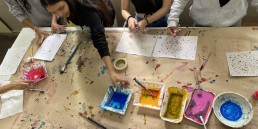
As Luis Camnitzer reminds us, the art is not in the object produced, but in the learning process it generates (Camnitzer, 2009). As Claire Bishop shows, participation in art is most powerful when it challenges us to think, act, and imagine together, turning creativity into a language of connection, reflection, and hope.
References:
Bishop, Claire. (2012). Artificial Hells: Participatory Art and the Politics of Spectatorship. Verso Books.
Camnitzer, Luis. (2009). Didactic Art: Art as Education. In Conceptualism in Latin American Art: Didactics of Liberation. University of Texas Press.
Freire, Paulo. (1970). Pedagogy of the Oppressed. Herder and Herder.
Office for Health Improvement & Disparities. (2022). Working definition of trauma-informed practice. GOV.UK. URL: https://www.gov.uk/government/publications/working-definition-of-trauma-informed-practice/working-definition-of-trauma-informed-practice
Henriksen, K. (1998). Kunsten at forme et sprog: Om udviklingshæmmede og den billedskabende proces. Gyldendal.
Visual arts activities





Contact
Iuliana Adriana PAVEL (project manager)
iuliana.pavel@a4action.ro
A4ACTION – Antim Ivireanu Culture House, Islaz Alley, Ghermănești, Snagov, Ilfov District, Romania, 077170
Co-funded by the European Union. Views and opinions expressed are however those of the author(s) only and do not necessarily reflect those of the European Union or the ANPCDEFP. Neither the European Union nor the ANPCDEFP can be held responsible for them.
The project is conducted by the following organisations: A4ACTION (Romania) – coordinator, Udruga Delta (Croatia), InterAktion (Austria), Asociación Espacio Rojo (Spain) and GAIA Museum Outsider Art (Denmark).