


The Creative Dinner Party

The Creative Dinner Party
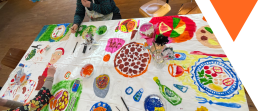
In this creative dinner party the participants imagine and paint their favorite meals onto a shared tablecloth. Guided by storytelling, they co-create a vibrant and colorful artwork that serves to reflect personal tastes, cultural identities, and obviously each participant’s creativity. By adding food, drinks, and utensils, the group builds a collective scene that celebrates diversity, inclusion, and self-expression in a playful and collaborative setting.

THEME
Inclusion, self-expression, cultural identity, co-creation through a creative “dinner”

COMPLEXITY
from beginner and up

GROUP SIZE
5-15
participants

AGE
13+

TIME
1
hour
Step-by-Step Instructions:
1. Introduction, material, demonstration (10 min.)
- Welcoming the participants to the creative dinner-party (sitting around the table with a tablecloth on or at the floor). It works best if the facilitator finds the proper storyline for setting the scene. Here is an example:
- Look at the empty tablecloth. What’s missing?
- Ask the participants about their personal favorite food.
- Trigger their imagination and tell them that we are visiting one of the finest restaurants in the world. At this restaurant they can be served whatever they want.
- But first everyone must paint it on the tablecloth.
2. Work (40 min.)
- What would you like to eat? Paint it on the tablecloth (have paint and brushes ready).
- In the process, it is essential to ask the participants what kind of tools they normally use at the dinner table, e.g. fingers, chopsticks, forks and knives, spoons etc. Paint them.
- What do you want to drink? What kind of glasses do you need? Paint them.
3. Reflection and Debriefing:
Reflection as a group (10 min.)
-
- Place the tablecloth on the floor. Look at it.
- Express what you see and think.
- The creative dinner-party has become a cooperative piece of art. Everyone has contributed and expressed their creativity and artistic way of work.
Debriefing
-
- After the painting process, everybody looks at the result, together. The discussion starts about the different kinds of meals at the table. What is the difference between them?

Debriefing and Evaluation:
The toy animal Lisa facilitates the debriefing process. Lisa asks the participants questions like:
- “What did you think of when you made this sculpture?”,
- “How was it to make the sculpture?”,
- “How was it to create with other people?”.
Make sure that Lisa examines all the sculptures and includes the participants in the conversation on the way around the garden. Maybe there are artists who want to show Lisa their sculpture themselves.
If you find it appropriate, include questions about the upcycling aspect of the workshop:
- “How do you see this now, that was trash just before?”
- “What can we bring into other aspects of our lives?
Tips for Facilitators:
- Talk positively about the process. Show your respect for everyone and the collective result.
- Remember there is no right or wrong way to be creative.
The Garbage Art Garden has become a cooperative piece of art. Everyone has contributed and expressed their creativity and artistic way of work, and The Trash Art Garden has become a very special piece of art with a lot of different expressions.

Variations and adjustments:
- Can be other settings than a garden – a village, a museum, a festival, a circus, etc. Instead of the toy animal it could be another facilitator that comes to see the garden in the end. It can be anything and have different forms, imagination and personality.

Disclaimer:
- Be aware of choking hazards.
Visual arts activities




Contact
Iuliana Adriana PAVEL (project manager)
iuliana.pavel@a4action.ro
A4ACTION – Antim Ivireanu Culture House, Islaz Alley, Ghermănești, Snagov, Ilfov District, Romania, 077170
Co-funded by the European Union. Views and opinions expressed are however those of the author(s) only and do not necessarily reflect those of the European Union or the ANPCDEFP. Neither the European Union nor the ANPCDEFP can be held responsible for them.
The project is conducted by the following organisations: A4ACTION (Romania) – coordinator, Udruga Delta (Croatia), InterAktion (Austria), Asociación Espacio Rojo (Spain) and GAIA Museum Outsider Art (Denmark).


Remixing tradition
Remixing tradition
Participants collaboratively explore traditional music and dance from their regions, working together to create new expressions inspired by these traditions. This method uses dance, music and songwriting to foster inter-cultural dialogue, creativity and tolerance. Both by honouring and questioning different traditional songs and dances, it aims at connection with cultural heritage and open a dialogue between tradition and contemporary topics and social issues.
THEME
Intercultural dialogue, tradition, inclusion and diversity

COMPLEXITY
Advanced
GROUP SIZE
15-20
participants
AGE
15+
TIME
110
min.
Step-by-Step Instructions:
- Introduction (5 min): Explain the purpose of the activity (cultural exchange, self-expression, creating “new traditions” by remixing traditional dances and songs).
- Breaking the ice (15 min): At the beginning, the participants stand in a circle, and throw a ball to each other. In the first round, whoever gets the ball must say a word that answers the question “What does tradition mean to you?”. If you work with a group of people who don’t know each other, incorporate a name game previously.
- Traditional music and dances (35 min): Participants are invited to reflect on their country or region’s traditional music and/or dances. If some participants know a song or some steps, they can teach the others some simple steps or melodies. If not, they can research online and find a video representing their tradition to share with others. The group then watches together a couple of videos and reflects on the differences and similarities of the folk music and dances they’ve seen. They should name the characteristics of traditional and folk expression, what topics they represent, what was the life of people when it was created compared to today, and how they feel towards it. The group is then divided in two – one group chooses a song from any cultural background they watched, and the other group chooses a dance. They are given 15-20 minutes to rehearse a couple of verses/steps.
- New tradition (40 min): Now the participants are given the task to use the verses and steps they’ve learned and rehearsed to create some modified song or dance that can resemble the traditional dances and songs, but can be altered using any kind of creative expression. For instance, they can mix different region’s materials, add some new motifs, words or steps that might come from contemporary dances or topics. They can express the song’s topic in a new way, changing the lyrics and the dance movements in a contemporary way. Each group should practice their newly created material a few times, making sure to reach a choreography and mutual pace. They can repeat the sequence in a “loop” a couple of times and add an ending. The groups then show each other their short song and choreography. At the end the whole group can try to do it simultaneously, blending the song and dance into one performance.
- Reflection and evaluation (15 min): The participants sit in a circle and share thoughts on the shared experience.
Reflection Questions:
-
- How was the exercise for you?
- Was it difficult to learn a traditional song/dance and modify it?
- What was the most interesting part?
- Did your view on ‘tradition’ change in some way?
For evaluation, observe participant engagement and mood, the way they react to the assignment and how they collaborate in groups. Collect feedback verbally, via a quick survey or through association cards.
Tips for Facilitators:
- Create a welcoming and non-judgmental atmosphere.
- Make sure the participants feel comfortable and free to express themselves.
- Provide extra support to participants who might struggle with the task.
Variations and adjustments:
- This activity can be modified for discussing different topics and social issues. This can be done by changing the topic of the traditional song that is being altered, or the moves in the dance that send different messages. For instance, the facilitator can prepare in advance some words like: democracy, climate change, gender (in)equality, solidarity, peace, and so on, and the group chooses one of them as the topic for creating their remix of the traditional dance/song.
- If there is not enough time or the group is smaller, the method can be focused on only a song or a dance.
- If there is more time and the group discussion is fruitful, deeper questions can be raised related to tradition, identity and culture.
- If the group can work together continuously for a period of time, the remixed song/dance can be further developed and rehearsed, and even performed in front of an audience.
Disclaimer:
- The activity is especially interesting for participants that come from different cultures in a mixed group. Be mindful about their relationship with tradition and explain that the activity is about creation with tradition and connecting with it, as well as intercultural exchange, without any intention to dishonour tradition. This can be well communicated from the start, even in the invitation and description of the activity.


Contact
Iuliana Adriana PAVEL (project manager)
iuliana.pavel@a4action.ro
A4ACTION – Antim Ivireanu Culture House, Islaz Alley, Ghermănești, Snagov, Ilfov District, Romania, 077170
Co-funded by the European Union. Views and opinions expressed are however those of the author(s) only and do not necessarily reflect those of the European Union or the ANPCDEFP. Neither the European Union nor the ANPCDEFP can be held responsible for them.
The project is conducted by the following organisations: A4ACTION (Romania) – coordinator, Udruga Delta (Croatia), InterAktion (Austria), Asociación Espacio Rojo (Spain) and GAIA Museum Outsider Art (Denmark).