


The Trash Art Garden

The Trash Art Garden
In The Trash Art Garden, participants transform recycled materials into unique sculptures through a playful storytelling experience. The participants co-create an imaginative “garden” where creativity, inclusion, and self-expression flourish. Each participant contributes their own artwork, which in the end becomes part of a shared installation. The activity fosters collaboration, celebrates diversity, and encourages reflection on creativity and upcycling in a safe, supportive environment.

THEME
Inclusion, self-expression, co-creation

COMPLEXITY
Beginner

GROUP SIZE
5-15
participants

AGE
13+

TIME
60
minutes
Step-by-Step Instructions:
- Introduction (10 minutes)
- The piece of fabric is on the entire length of the table. It is a beautiful old garden. All the recycled material, pieces and scraps and glue are ready on the table. The friendly toy animal Lisa is sitting in the garden.
- The facilitator begins by setting the scene through storytelling. The words and level of guidance is adjusted to the group’s abilities. The facilitator can use the story of the animal toy Lisa:
- It greets the participants and asks them to sit down around the table and it tells them that this is its garden.
- Everything in the garden has fallen apart and the participants are asked to help out.
- Would you like to help me? (Everyone would love to help)
- You can find the glue and the lost pieces on the table.
- Now we will put the lost pieces together and make new fabulous sculptures.
- Individual creative work (35 min.)
- Everyone starts to work on their own sculpture.
- If needed, you could help the participants in their individual process with inspiration, practical advice etc.
- Listen carefully to the participants while they are working. What do they say about their process?
- Co-creating and completion (15 min.)
- When the participants have made their individual sculpture, the facilitator will say something like “What lovely sculptures we made. Now we will place them in the garden. And the leftover pieces, we didn’t use, we will put in the empty box”.
- Everyone places their sculpture in the garden. Now the friendly toy animal Lisa is going to visit the garden.

Debriefing and Evaluation:
The toy animal Lisa facilitates the debriefing process. Lisa asks the participants questions like:
- “What did you think of when you made this sculpture?”,
- “How was it to make the sculpture?”,
- “How was it to create with other people?”.
Make sure that Lisa examines all the sculptures and includes the participants in the conversation on the way around the garden. Maybe there are artists who want to show Lisa their sculpture themselves.
If you find it appropriate, include questions about the upcycling aspect of the workshop:
- “How do you see this now, that was trash just before?”
- “What can we bring into other aspects of our lives?
Tips for Facilitators:
- Talk positively about the process. Show your respect for everyone and the collective result.
- Remember there is no right or wrong way to be creative.
The Garbage Art Garden has become a cooperative piece of art. Everyone has contributed and expressed their creativity and artistic way of work, and The Trash Art Garden has become a very special piece of art with a lot of different expressions.

Variations and adjustments:
Can be other settings than a garden – a village, a museum, a festival, a circus, etc. Instead of the toy animal it could be another facilitator that comes to see the garden in the end. It can be anything and have different forms, imagination and personality.

Disclaimer:
- Be aware of choking hazards.
Visual arts activities
Nothing found.

Contact
Iuliana Adriana PAVEL (project manager)
iuliana.pavel@a4action.ro
A4ACTION – Antim Ivireanu Culture House, Islaz Alley, Ghermănești, Snagov, Ilfov District, Romania, 077170
Co-funded by the European Union. Views and opinions expressed are however those of the author(s) only and do not necessarily reflect those of the European Union or the ANPCDEFP. Neither the European Union nor the ANPCDEFP can be held responsible for them.
The project is conducted by the following organisations: A4ACTION (Romania) – coordinator, Udruga Delta (Croatia), InterAktion (Austria), Asociación Espacio Rojo (Spain) and GAIA Museum Outsider Art (Denmark).

The Creative Dinner Party
The Creative Dinner Party
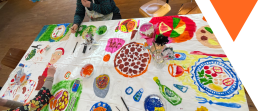
In this creative dinner party the participants imagine and paint their favorite meals onto a shared tablecloth. Guided by storytelling, they co-create a vibrant and colorful artwork that serves to reflect personal tastes, cultural identities, and obviously each participant’s creativity. By adding food, drinks, and utensils, the group builds a collective scene that celebrates diversity, inclusion, and self-expression in a playful and collaborative setting.
THEME
Inclusion, self-expression, cultural identity, co-creation through a creative “dinner”

COMPLEXITY
from beginner and up
GROUP SIZE
5-15
participants
AGE
13+
TIME
1
hour
Step-by-Step Instructions:
1. Introduction, material, demonstration (10 min.)
- Welcoming the participants to the creative dinner-party (sitting around the table with a tablecloth on or at the floor). It works best if the facilitator finds the proper storyline for setting the scene. Here is an example:
- Look at the empty tablecloth. What’s missing?
- Ask the participants about their personal favorite food.
- Trigger their imagination and tell them that we are visiting one of the finest restaurants in the world. At this restaurant they can be served whatever they want.
- But first everyone must paint it on the tablecloth.
2. Work (40 min.)
- What would you like to eat? Paint it on the tablecloth (have paint and brushes ready).
- In the process, it is essential to ask the participants what kind of tools they normally use at the dinner table, e.g. fingers, chopsticks, forks and knives, spoons etc. Paint them.
- What do you want to drink? What kind of glasses do you need? Paint them.
3. Reflection and Debriefing:
Reflection as a group (10 min.)
-
- Place the tablecloth on the floor. Look at it.
- Express what you see and think.
- The creative dinner-party has become a cooperative piece of art. Everyone has contributed and expressed their creativity and artistic way of work.
Debriefing
-
- After the painting process, everybody looks at the result, together. The discussion starts about the different kinds of meals at the table. What is the difference between them?
Debriefing and Evaluation:
The toy animal Lisa facilitates the debriefing process. Lisa asks the participants questions like:
- “What did you think of when you made this sculpture?”,
- “How was it to make the sculpture?”,
- “How was it to create with other people?”.
Make sure that Lisa examines all the sculptures and includes the participants in the conversation on the way around the garden. Maybe there are artists who want to show Lisa their sculpture themselves.
If you find it appropriate, include questions about the upcycling aspect of the workshop:
- “How do you see this now, that was trash just before?”
- “What can we bring into other aspects of our lives?
Tips for Facilitators:
- Talk positively about the process. Show your respect for everyone and the collective result.
- Remember there is no right or wrong way to be creative.
The Garbage Art Garden has become a cooperative piece of art. Everyone has contributed and expressed their creativity and artistic way of work, and The Trash Art Garden has become a very special piece of art with a lot of different expressions.
Variations and adjustments:
- Can be other settings than a garden – a village, a museum, a festival, a circus, etc. Instead of the toy animal it could be another facilitator that comes to see the garden in the end. It can be anything and have different forms, imagination and personality.
Disclaimer:
- Be aware of choking hazards.
Visual arts activities
Nothing found.
Contact
Iuliana Adriana PAVEL (project manager)
iuliana.pavel@a4action.ro
A4ACTION – Antim Ivireanu Culture House, Islaz Alley, Ghermănești, Snagov, Ilfov District, Romania, 077170
Co-funded by the European Union. Views and opinions expressed are however those of the author(s) only and do not necessarily reflect those of the European Union or the ANPCDEFP. Neither the European Union nor the ANPCDEFP can be held responsible for them.
The project is conducted by the following organisations: A4ACTION (Romania) – coordinator, Udruga Delta (Croatia), InterAktion (Austria), Asociación Espacio Rojo (Spain) and GAIA Museum Outsider Art (Denmark).

The sound of textures
The sound of textures
This method merges crafting and music, while exploring the topic of textures. Participants explore the sounds of different textures and express their feelings through drumming. They collaboratively create simple DIY percussion instruments from recycled materials and discover their group rhythm by playing the instruments they’ve crafted. It develops creativity, group cohesion and a sustainable mindset (using recycled materials).
THEME
Exploring textures through recycling and music

COMPLEXITY
Advanced
GROUP SIZE
15-20
participants
AGE
13+
TIME
150
min.
Step-by-Step Instructions:
- Introduction (5 min): Explain the purpose of the activity (exploring materials and textures though sound, recycled crafting, jointly music making).
- The sound of textures (15 min): At the beginning of the activity, participants are introduced to the concept, importance, and various types of textures. Textures refer to the perceived quality of an object, experienced through sight or touch. The facilitator explains the difference between visual textures (such as color arrangements, intensities, and brushstroke qualities) and tactile or surface textures (how something feels to the touch), discussing their roles in art, design, and everyday life. Participants then observe and explore various materials by touch, describing their textures using adjectives like smooth, soft, rough, coarse, or glassy. Following this, they are invited to explore how different textures can produce different sounds and how these sounds can be used to express different moods. Each participant demonstrates a texture-related sound, and the group discusses the materials used, how the textures affect us, and how we can creatively use them.
- Crafting recycled instruments (60 min): Participants are divided into small groups of three and tasked with creating simple percussion instruments using various textures and recycled materials. While each participant builds their own instrument, they collaborate and support one another within their group. The facilitator guides them through the entire process—from brainstorming and design to construction and decoration—encouraging creativity and teamwork throughout.
- Presentation and jam session (60 min): In this part of the activity, participants present their instruments and demonstrate the sounds they produce. They are encouraged to share their creative process, including which materials they chose and why. They reflect about the used materials, noticing the differences of sound based on texture and how the instrument is played. Following the presentations, the entire group explores their collective sound and engages in a jam session, experimenting with rhythm and attempting to find a shared groove. The facilitator records the session to capture the group’s unique musical expression.
- Reflection and evaluation (10 min): At the end of the activity, the group gathers in a circle to share their thoughts and reflections. The facilitator poses guiding questions, and participants are invited to raise their hands if they wish to share. To conclude, the facilitator leads a final round in which each participant sums up their experience in one word and/or shares what they are taking away from the activity—what they learned or found meaningful. Participants may take their instruments home or keep them for use in future activities.
Reflection Questions:
-
- Was this an interesting way to learn about textures?
- What was the most interesting part?
For evaluation, observe participant engagement and mood, the way they react to the assignment and how they collaborate in groups. Collect feedback verbally, via a quick survey online or through association cards.
Tips for Facilitators:
- Create a welcoming and non-judgmental atmosphere.
- Make sure the participants feel comfortable and free to express themselves.
- Provide extra support to participants who might struggle with the task.
- To ensure all aspects of the activity are carried out safely and effectively, it is recommended that more than one facilitator leads the session.
Variations and adjustments:
- If conditions allow, participants can also be invited to bring their own recycled materials from home to contribute to the activity and deepen their sense of responsibility and thoughts on recycling.
- The activity can be split into more days (2-3) to avoid tiredness and loss of concentration.
- The activity can help strengthen relationships among students—especially if they already know each other—and enhance their sense of group cohesion. By creating music together and discovering their shared rhythm, participants develop a stronger group identity and connection.
- The activity can be particularly engaging for participants from cultures where music—especially drumming and clapping—plays an important role in daily life. The opportunity to make “noise” or music in a structured and creative way can capture their interest more effectively than traditional or formal teaching methods, keeping them actively involved throughout the activity.
Disclaimer:
- Extra caution must be taken to ensure safety, as participants may use potentially hazardous tools such as hammers and nails.
Music and movement activities
Nothing found.
Contact
Iuliana Adriana PAVEL (project manager)
iuliana.pavel@a4action.ro
A4ACTION – Antim Ivireanu Culture House, Islaz Alley, Ghermănești, Snagov, Ilfov District, Romania, 077170
Co-funded by the European Union. Views and opinions expressed are however those of the author(s) only and do not necessarily reflect those of the European Union or the ANPCDEFP. Neither the European Union nor the ANPCDEFP can be held responsible for them.
The project is conducted by the following organisations: A4ACTION (Romania) – coordinator, Udruga Delta (Croatia), InterAktion (Austria), Asociación Espacio Rojo (Spain) and GAIA Museum Outsider Art (Denmark).

Remixing tradition
Remixing tradition
Participants collaboratively explore traditional music and dance from their regions, working together to create new expressions inspired by these traditions. This method uses dance, music and songwriting to foster inter-cultural dialogue, creativity and tolerance. Both by honouring and questioning different traditional songs and dances, it aims at connection with cultural heritage and open a dialogue between tradition and contemporary topics and social issues.
THEME
Intercultural dialogue, tradition, inclusion and diversity
COMPLEXITY
Advanced
GROUP SIZE
15-20
participants
AGE
15+
TIME
110
min.
Step-by-Step Instructions:
- Introduction (5 min): Explain the purpose of the activity (cultural exchange, self-expression, creating “new traditions” by remixing traditional dances and songs).
- Breaking the ice (15 min): At the beginning, the participants stand in a circle, and throw a ball to each other. In the first round, whoever gets the ball must say a word that answers the question “What does tradition mean to you?”. If you work with a group of people who don’t know each other, incorporate a name game previously.
- Traditional music and dances (35 min): Participants are invited to reflect on their country or region’s traditional music and/or dances. If some participants know a song or some steps, they can teach the others some simple steps or melodies. If not, they can research online and find a video representing their tradition to share with others. The group then watches together a couple of videos and reflects on the differences and similarities of the folk music and dances they’ve seen. They should name the characteristics of traditional and folk expression, what topics they represent, what was the life of people when it was created compared to today, and how they feel towards it. The group is then divided in two – one group chooses a song from any cultural background they watched, and the other group chooses a dance. They are given 15-20 minutes to rehearse a couple of verses/steps.
- New tradition (40 min): Now the participants are given the task to use the verses and steps they’ve learned and rehearsed to create some modified song or dance that can resemble the traditional dances and songs, but can be altered using any kind of creative expression. For instance, they can mix different region’s materials, add some new motifs, words or steps that might come from contemporary dances or topics. They can express the song’s topic in a new way, changing the lyrics and the dance movements in a contemporary way. Each group should practice their newly created material a few times, making sure to reach a choreography and mutual pace. They can repeat the sequence in a “loop” a couple of times and add an ending. The groups then show each other their short song and choreography. At the end the whole group can try to do it simultaneously, blending the song and dance into one performance.
- Reflection and evaluation (15 min): The participants sit in a circle and share thoughts on the shared experience.
Reflection Questions:
-
- How was the exercise for you?
- Was it difficult to learn a traditional song/dance and modify it?
- What was the most interesting part?
- Did your view on ‘tradition’ change in some way?
For evaluation, observe participant engagement and mood, the way they react to the assignment and how they collaborate in groups. Collect feedback verbally, via a quick survey or through association cards.
Tips for Facilitators:
- Create a welcoming and non-judgmental atmosphere.
- Make sure the participants feel comfortable and free to express themselves.
- Provide extra support to participants who might struggle with the task.
Variations and adjustments:
- This activity can be modified for discussing different topics and social issues. This can be done by changing the topic of the traditional song that is being altered, or the moves in the dance that send different messages. For instance, the facilitator can prepare in advance some words like: democracy, climate change, gender (in)equality, solidarity, peace, and so on, and the group chooses one of them as the topic for creating their remix of the traditional dance/song.
- If there is not enough time or the group is smaller, the method can be focused on only a song or a dance.
- If there is more time and the group discussion is fruitful, deeper questions can be raised related to tradition, identity and culture.
- If the group can work together continuously for a period of time, the remixed song/dance can be further developed and rehearsed, and even performed in front of an audience.
Disclaimer:
- The activity is especially interesting for participants that come from different cultures in a mixed group. Be mindful about their relationship with tradition and explain that the activity is about creation with tradition and connecting with it, as well as intercultural exchange, without any intention to dishonour tradition. This can be well communicated from the start, even in the invitation and description of the activity.
Music and movement activities
Nothing found.
Contact
Iuliana Adriana PAVEL (project manager)
iuliana.pavel@a4action.ro
A4ACTION – Antim Ivireanu Culture House, Islaz Alley, Ghermănești, Snagov, Ilfov District, Romania, 077170
Co-funded by the European Union. Views and opinions expressed are however those of the author(s) only and do not necessarily reflect those of the European Union or the ANPCDEFP. Neither the European Union nor the ANPCDEFP can be held responsible for them.
The project is conducted by the following organisations: A4ACTION (Romania) – coordinator, Udruga Delta (Croatia), InterAktion (Austria), Asociación Espacio Rojo (Spain) and GAIA Museum Outsider Art (Denmark).

Rhythm playfield
Rhythm playfield
The activity encourages participants to produce and engage with rhythm using their body and surroundings. It develops rhythm play culminating in group drumming experience. Through simple rhythm games and exercises, they develop body awareness and enhance group cohesion in a playful and engaging manner.
THEME
Getting in tune with self and others through rhythm

COMPLEXITY
Intermediate
GROUP SIZE
10-15
participants
AGE
13+
TIME
80
min.
Step-by-Step Instructions:
- Introduction (5 min): Explain the purpose of the activity.
- Simple rhythm game (15min): Facilitator encourages the group to remember rhythm games they played as children with one another, using hands for clapping with other people in pairs or groups. The facilitator goes first and shows the game with the group, demonstrating with one or multiple people from the group. The rest of the group is encouraged to form their own pairs or smaller groups and follow the facilitator’s group. Then, volunteers are called to share with the group. They demonstrate and the rest of the group follows. Optional: Facilitators share a rhythm game done in a pair, and then encourage volunteers to show games done in bigger and bigger groups, finishing in a big circle.
- Rhythmic movement (15min): The facilitator explains the point of the exercise – to follow another’s movement with rhythm. Participants are split in pairs. Each person has 5 minutes for rhythmic movement, and the task of their pair is to follow their movement with rhythm produced in a way they wish – with hands, on objects, with simple percussion instruments (if available). The rhythm should try to match the other persons’ movement as best as possible. Then, the roles are switched. If there are visually impaired people, instead of movement the other person can use the voice or their own rhythm.
- Dancing to the beat (35min): The group is split in two. The first group sits in a circle and develops their own rhythmic concert, using their body, objects, floor, or instruments. The facilitator explains that they should improvise, but also listen to each other and try to explore together. The second group is the audience and after some time, the facilitator encourages them to get up and start dancing to the music. Then, the groups switch roles.
- Reflection and evaluation (10 min): Participants sit in a circle and share thoughts on how the activity was for them.
Reflection Questions:
-
- What was this experience like for you?
- How did you feel with the rhythm? Was it easy or hard for you to complete the tasks?
- Was there something that surprised you? Which part of the experience was the most impactful for you?
- Did you learn something new about yourself and others during the activities?
For evaluation, observe participant engagement and mood, the way they react to the assignment and how they collaborate in groups. Collect feedback verbally, via a quick survey or through associative cards.
Tips for Facilitators:
- Create a welcoming and non-judgmental atmosphere.
- Make sure the participants feel comfortable and free to express themselves.
- The room should be safe (free of sharp edges) and spacious enough to allow for unrestricted movement. The floor should not be slippery.
- Instruments provided should be fairly simple to use, without small parts that could get lost or come underfoot.
- It is important to keep in mind that some participants may need additional physical support during the activity.
Variations and adjustments:
- Variations depend on the space available. If there are two separate rooms, the last exercise can be done differently – two smaller groups can rehearse in their own space, and the facilitator can lead one by one group to the others’ space to dance, and then lead them out.
Music and movement activities
Nothing found.
Contact
Iuliana Adriana PAVEL (project manager)
iuliana.pavel@a4action.ro
A4ACTION – Antim Ivireanu Culture House, Islaz Alley, Ghermănești, Snagov, Ilfov District, Romania, 077170
Co-funded by the European Union. Views and opinions expressed are however those of the author(s) only and do not necessarily reflect those of the European Union or the ANPCDEFP. Neither the European Union nor the ANPCDEFP can be held responsible for them.
The project is conducted by the following organisations: A4ACTION (Romania) – coordinator, Udruga Delta (Croatia), InterAktion (Austria), Asociación Espacio Rojo (Spain) and GAIA Museum Outsider Art (Denmark).

Dancing words
Dancing words
Participants are led to a visualization exercise based on a certain topic or question related to a social issue (such as equality, inclusion, sustainability). Based on this, they engage in flow writing and then create a dance improvisation related to the text from the previous task. This method connects movement and writing, which leads to embodying ideas, emotions and sparking a discussion on social topics.
THEME
Self-expression, personal development, social issues, inclusion
COMPLEXITY
Intermediate
GROUP SIZE
15-20
participants
AGE
13+
TIME
110
min.
Step-by-Step Instructions:
- Introduction (5 mins): Explain the purpose of the activity (dance improvisation, self-expression, human rights, relationship between self and society).
- Breaking the ice (25 min): If the group is meeting for the first time or consists of mixed participants, begin with a preparatory activity such as a name game. It’s also important to include a body scan, grounding exercise, or warm-up to help participants relax and connect with their bodies, the floor, to breathe and let go of all the worries. You can also use 1-2 introduction activities from the additional chapter at the end of the Toolbox, based on your needs.
- Visualization and flow writing (30 min): Participants are invited to find a spot in the room and a comfortable position (they can sit, lay down on the floor, but should take a relaxed body position). The facilitator then leads a visualisation exercise to imagine for instance a happy place in nature, or an ideal city/community/world, depending on a topic or question (e.g. “How would a world with complete equality/inclusion/sustainability look like?”). The participants visualize it using all the senses in their imagination and to connect with feelings (“How does this place/world make you feel? What are the textures/colours/shapes that you see? What are the sounds, the smells?”). Then, they are invited to come back to the present, but with the visualization in mind. The facilitator hands out papers and pens and invites the participants to engage in ‘flow writing’, related to their visualization. That is, they can write freely their flow of thoughts without worrying too much about whether the text is coherent or structured. The important thing is that they try to unwind and write down their thoughts and feelings as freely as possible, without judgement, letting the flow take over. They can write whatever comes to mind—how they’re feeling right now, what they’ve been thinking about in the visualization, what did the world they imagined look like, what problems do they see related to the topic/question in the real world compared to the imagined world, or just anything that’s on their mind. This should last for 10 to 15 minutes. In the end, they are asked to circle out three key words from what they’ve written: a noun, verb and adjective (if possible). Provide an explanation with examples if some participants don’t understand these words.
- Dance improvisation (35 min): Now the participants are given the task to create a small improvisation dance based on their three key words. The facilitator begins with a quick warming-up in a circle, and gradually lets the participants slip into their own movement. Their three key words are serving them as guide and inspiration for the movement, while music is played. The participants are encouraged to explore the movement and exercise their improvisation until they have a fixed small choreography. This part should last about 10-15 minutes. If there is time left, half the group can show their choreographies by performing for the other half as the audience, and vice versa. Afterward, the group gathers in a circle to share how it felt, what the key words were, and how they translated them into movement/dance.
- Reflection and evaluation (15 min): The participants sit in a circle and reflect about how the activity was for them, sharing thoughts and discussing.
Reflection Questions:
-
- How was the exercise for you?
- What feelings emerged in the visualization?
- Was it difficult to translate the words into movement?
- Do you think such a place/community/world is possible? If not, why? If yes, what should happen to direct us towards this vision?
For evaluation, observe participant engagement and mood, the way they move and what they share in the reflection/discussion. Collect feedback verbally, via a quick survey or through association
Tips for Facilitators:
- Create a welcoming and non-judgmental atmosphere.
- Make sure the participants feel comfortable and free to express themselves.
- Be mindful of participants’ sensitivities – avoid forcing anyone to participate/move more than they are comfortable. Remind participants that dance is not about the perfect movement, but self-discovery and a special encounter with others through non-verbal bodily communication.
Variations and adjustments:
- This activity can be modified for discussing different topics and social issues. This can be done by changing the visualization exercise accordingly.
- For younger participants or beginners: Simplify the visualisation and writing prompts. Instead of complex social issues, use more relatable themes such as “a place where you feel safe” or “your happiest memory.” Shorten the writing segment and focus more on simple movement expression (e.g. using shapes, directions, or emotions like happy/sad/angry).
- To deepen the experience: Invite participants to work in pairs or small groups for the final improvisation. They can create a short choreography together based on their combined key words. This promotes cooperation and adds a social layer to the creative process.
- Provide extra support for participants who may have difficulty with writing or movement. This can include offering words of encouragement, demonstrating the task with an example, or providing a chair for those who have trouble standing.
- For multilingual or mixed-language groups: Allow participants to write in their native language and, if willing, translate or explain key words later. Alternatively, encourage them to express the meaning through movement without needing to explain verbally.
- For groups with trauma sensitivity or emotional vulnerability: Focus the activity on more neutral or uplifting themes (e.g. hope, nature, dreams). Offer participants the option to opt out of specific parts (e.g., performance), and emphasize emotional safety throughout the process.
Music and movement activities
Nothing found.
Contact
Iuliana Adriana PAVEL (project manager)
iuliana.pavel@a4action.ro
A4ACTION – Antim Ivireanu Culture House, Islaz Alley, Ghermănești, Snagov, Ilfov District, Romania, 077170
Co-funded by the European Union. Views and opinions expressed are however those of the author(s) only and do not necessarily reflect those of the European Union or the ANPCDEFP. Neither the European Union nor the ANPCDEFP can be held responsible for them.
The project is conducted by the following organisations: A4ACTION (Romania) – coordinator, Udruga Delta (Croatia), InterAktion (Austria), Asociación Espacio Rojo (Spain) and GAIA Museum Outsider Art (Denmark).

Sound = movement = drawing
Sound = movement = drawing
Participants collaboratively create an abstract drawing inspired by music and movement, using ad hoc created ‘drawing mechanisms’. The lines in the drawing serve as a visual documentation of movement— like an extension of the body—shaped by the rhythm of music and sound.
THEME
Co-creation, group building, inclusion, synesthesia
COMPLEXITY
Can be modified depending on the participants
GROUP SIZE
10-15
participants
AGE
13+
TIME
At least 60 minutes (can be prolonged to 90min, depending on the context)
Objectives
- Foster creativity, spontaneity and experimentation
- Develop a sense of collaboration through collective creation
- Create a feeling of ownership
- Celebrate diversity and inclusion
- Connect different art media which enables the connection of different senses (synesthesia)
Materials
- A big piece of paper (at least 1 meter wide and 3-4 meters long) of thicker quality, alternatively a white textile material.
- A music play-list and reproduction device (for instance, mobile phone and portable Bluetooth speakers).
- Drawing utensils (pens and pencils, markers, charcoal, ink, brushes and paint…).
- Different tools and items to create ‘drawing mechanisms’ (sticks, umbrellas, kitchenware, adhesive tape, fabric string).
Overview
Participants collaboratively create an abstract drawing inspired by music and movement, using ad hoc created ‘drawing mechanisms’. The lines in the drawing serve as a visual documentation of movement— like an extension of the body—shaped by the rhythm of music and sound.
Step-by-Step Instructions:
- Introduction (10 min): Set up the room and prepare the materials. Explain the purpose of the activity (expression, collaboration, inclusion, synesthetic experience, and exploration). Make a name game ice-breaker or ‘getting to know each other’ activity if the participants don’t know each other. Divide the participants into smaller groups.
Outline the rules:
-
- Work in smaller groups.
- Move and draw in response to the music. Refrain from drawing figurative images, but think of the lines as “movement on paper”.
- Use only non-dominant hands or other body parts to draw.
- Avoid walking on the paper. You can walk on the paper only barefoot and if drawing with your feet.
In the second part:
-
- Use the provided tools and items to assemble a ‘drawing mechanism’.
- Materials set-up and demonstration (5 min): Distribute the materials. Demonstrate how to use different body parts (except the dominant hand) by patching up drawing utensils to feet, elbows, fingers and so on, by helping each other in the smaller groups.
- Drawing creation (at least 30 min): Participants collaboratively create an abstract drawing while following the set rules. The facilitator gradually introduces new tasks and variations. The music rhythm is changed periodically to influence movement and drawing dynamics. In the second half the task to create ‘drawing mechanisms’ is introduced and demonstrated.

- Reflection and evaluation (15 min): Participants step back to observe the drawing that represents their collective artwork. They share their thoughts and impressions on the process and outcome.

The final experimental collective artwork can be displayed in a shared space where the group spends time together or in a public setting. Alternatively, it can be cut into smaller pieces to be exhibited in that form or given to participants as a keepsake and reminder of the experience.
Reflection Questions:
-
- How did creating the drawing make you feel?
- What was the most difficult part and how did you overcome it?
- What did you learn about yourself and others through this process?
For evaluation, observe participant engagement and their willingness to share, the way they react to the assignment and how they collaborate in groups. Collect feedback verbally or via a quick survey.
Tips for Facilitators:
- Give clear instructions, offer some rules and demonstrate first.
- Read the room. Add tasks if/when needed.
- Adapt the activity to specific needs of the group.
- Provide extra support to participants who might struggle with self-expression.
- It’s important to create a safe and brave space by encouraging mutual respect, openness, and inclusivity. Invite participants to be mindful of each other’s well-being, ensuring safety and consent in all interactions. Foster an environment where everyone feels comfortable expressing themselves while also respecting personal boundaries.
- Encourage participants to embrace exploration and experimentation in artistic expression, emphasizing that there is no right or wrong. Invite them to let go of self-judgment, stay open to the process, and enjoy the experience. Most importantly, remind them to have fun!
Variations and adjustments:
- The duration of the activity can be extended depending on the time frame and number of participants. The dimensions of the paper should be adjusted based on the room size, as well as the number and type of participants. It can be done as a public or closed event.
- The activity can be framed around a topic that is relevant to the group’s current context. For example, in a class approaching the end of high school, the activity can serve as a creative reflection on their shared experiences. It can be adapted to include a music playlist created by them to represent their high school years as the basis for the drawing component, and an introductory segment where participants share stories, memories, and anecdotes from their time as a class.
- It is essential to closely follow the group dynamics and remain flexible, especially when working with highly vulnerable groups. The facilitator should adapt the activity to the specific needs, abilities, and engagement levels of the participants, modifying the complexity as needed. For example, certain elements—such as drawing with the non-dominant hand, using other body parts and mechanisms, or creating a group drawing—can be omitted if they seem too challenging or uncomfortable for the group.
- If it’s difficult for participants to draw on paper on the floor, provide a big table (or connect more tables) so they can draw while sitting.

- For advanced groups or when time allows, the background music can be replaced with the conductor exercise. This requires dividing participants into two groups—one acting as a choir and the other drawing. The choir produces sounds (each participant choosing their own) based on the conductor’s instructions. After some time, the groups switch roles. This variation requires two facilitators.
- When working with participants with developmental disabilities, it is important to simplify the workshop structure to ensure accessibility and inclusivity. Incorporating smaller preparatory tasks before the drawing activity—such as warm-up exercises, group movement, clapping rhythms, listening to music, or imagining colors—can help participants engage more comfortably and gradually ease into the creative process.
Disclaimer:
- When implementing this activity with a group of young people with whom you don’t work regularly and they have special needs, is important to get informed about their specific needs beforehand from the youth workers/social workers that are working with them on a regular basis, in order to adjust the activity
Music and movement activities
Nothing found.
Contact
Iuliana Adriana PAVEL (project manager)
iuliana.pavel@a4action.ro
A4ACTION – Antim Ivireanu Culture House, Islaz Alley, Ghermănești, Snagov, Ilfov District, Romania, 077170
Co-funded by the European Union. Views and opinions expressed are however those of the author(s) only and do not necessarily reflect those of the European Union or the ANPCDEFP. Neither the European Union nor the ANPCDEFP can be held responsible for them.
The project is conducted by the following organisations: A4ACTION (Romania) – coordinator, Udruga Delta (Croatia), InterAktion (Austria), Asociación Espacio Rojo (Spain) and GAIA Museum Outsider Art (Denmark).

Moving clay
Moving clay
This method connects music improvisation and visual arts, while using uncommon materials for both. Participants engage in co-creation by making sound with everyday objects and by painting with their hands using tactile materials, such as clay, slime, charcoal and seeds. The activities emphasize the playfulness and openness in art making, focusing on the process and group cohesion rather than the results.
THEME
Artistic expression, group creation, music experimentation, tactile learning
COMPLEXITY
Intermediate
GROUP SIZE
15-20
participants
AGE
13+
TIME
60
min.
Step-by-Step Instructions:
- Introduction (10 min): The facilitator welcomes the participants and explains the workshop activities (music, movement and creating with non-conventional materials).
- Making music (10 min): The participants are asked to find some object in the room with which they can produce some sound. They try out different ways to make sound together with their object, experimenting with rhythms, volume etc.
- Music and tactile drawing (30 min): Now the participants are split into two groups. One group continues with making music while the other is placed around a blank paper, are offered some “unconventional” materials (clay, slime, soil, seeds) and are invited to draw with their hands, splashing the materials to the rhythms and flow of the music. After 10-15 minutes, the groups switch. The group that was drawing takes a couple of minutes to wash their hands, while the other group is given a new, blank piece of paper. The activity repeats as previously.
- Reflection and evaluation (10 min): The facilitator sums up the practice and invites the group to observe their two creations. Participants share how the activity was for them, what did they like/didn’t like, how they feel. The artwork can be cut into smaller pieces and exposed on the wall, or it can be sown in the soil somewhere outdoors, since all the materials are natural and the seeds might germinate and grow into a plant (if there’s some garden available and if it’s the right time of the year).
Reflection Questions:
-
- How was the workshop for you?
- Was it difficult to create music and to draw with your hands based on the music?
- What part did you like the most?
For evaluation, observe participant engagement and mood, the way they react to the assignment and how they collaborate in groups. Collect feedback verbally.
Tips for Facilitators:
- Create a welcoming and non-judgmental atmosphere.
- Make sure the participants feel comfortable and free to express themselves.
- Provide extra support to participants who might struggle with the task.
- Prepare the materials in advance. Mix the slime or natural glue with different food colours to get a more diverse palette.
- Provide a protective layer for the floor and some aprons for the participants to protect their clothes.
Variations and adjustments:
- This activity can be done with conventional painting materials if it’s not possible to provide clay, soil, natural glue and food colors.
- If it’s possible, some simple percussion instruments like the triangle and shakers can be used.
- The activity is suitable for an outdoor space like a garden or yard.
- If the group is large, divide participants into more than two groups to ensure everyone has space and feels included.
- The activity is particularly engaging for participants with developmental or learning disabilities, as it supports not only the development of creative skills but also promotes social interaction and self-confidence—outcomes that are especially valuable for individuals navigating developmental challenges. Tactile stimulation and open-ended experimentation with sound and visual arts can be highly rewarding, provided they are aligned with the participants’ needs and abilities.
- The activity can be engaging for young people with visual impairment, as it relies on tactile perception and sound.
- Instructional strategies should prioritize tactile and visual modes of learning by incorporating hands-on activities with clear, simple steps and consistent routines. Facilitators are encouraged to use inclusive pedagogical techniques such as modeling, repetition, and visual support to scaffold learning and ensure meaningful participation for all.
Music and movement activities
Nothing found.
Contact
Iuliana Adriana PAVEL (project manager)
iuliana.pavel@a4action.ro
A4ACTION – Antim Ivireanu Culture House, Islaz Alley, Ghermănești, Snagov, Ilfov District, Romania, 077170
Co-funded by the European Union. Views and opinions expressed are however those of the author(s) only and do not necessarily reflect those of the European Union or the ANPCDEFP. Neither the European Union nor the ANPCDEFP can be held responsible for them.
The project is conducted by the following organisations: A4ACTION (Romania) – coordinator, Udruga Delta (Croatia), InterAktion (Austria), Asociación Espacio Rojo (Spain) and GAIA Museum Outsider Art (Denmark).

Move the feeling
Move the feeling
The activity encourages participants to move, dance, and tune into their bodies’ needs. It supports the recognition and acceptance of both pleasant and unpleasant emotions, fostering awareness of bodily sensations through individual, paired, and group movement. A key element of the activity is the emphasis on consent—including non-verbal ways of giving and receiving it—and on being attentive and responsive to the person you are interacting with. Following the dance segment, a group discussion is held to help participants reflect on and integrate their experiences.
THEME
Personal development through movement and dance
COMPLEXITY
Intermediate
GROUP SIZE
15-20
participants
AGE
13+
TIME
90
min.
Step-by-Step Instructions:
- Introduction (5 min): Explain the purpose of the activity (movement and dance expression, body awareness and non-verbal communication).
- Breaking the ice (15 min): It’s really important to get participants into their bodies and connect with movement before starting the next activity. Use 1-2 introduction activities (name game, energizer, grounding) from the additional chapter at the end of the Toolbox, based on your needs. For example, ask the participants to move around the room with different prompts, like: walk as if you must catch the bus, walk as if you won the lottery, walk as if you were on the moon/the floor is on fire/made of ice.
- Connecting and warming up (25 min): Participants stand in a circle and hold hands (be sure to check if everyone is comfortable with this). The facilitator sends a signal (a hand squeeze) that travels around the circle. The facilitator changes directions and, at one point, sends the signal in both directions simultaneously.
Then, the facilitator leads a body scan and a couple of warming up exercises. Participants are invited to focus on their breathing and the sensations in their bodies, scanning each body part from head to toe and relaxing it. Here they should be invited to become more aware of the contact with the floor, of the room and of other participants. The warming up can be really basic and gentle, making circles with the main joints (neck, shoulders, pelvis, knees and ankles). Then, the participants are invited to continue to move freely as they like, in their place and then around the room, while the facilitator intensifies the music. - Movement and emotions (30 min): This session continues from the previous one in a flow. With music prepared in advance* by the facilitators, the group is guided to form pairs in the following way.
*Choose songs and compositions that are relatively neutral but capable of evoking various moods and emotions—such as classical, ethnic, instrumental, or atmospheric music.
Participants walk around the room while music plays in the background. They are guided to become aware of their bodies, muscles, and bodily sensations. They are encouraged to observe how their body wants to move and follow that instinct. After some time, they are invited to make contact with others in the group and sense the energy in the space. At one point, they stop and find the person nearest to them, forming pairs. In these pairs, guided by the facilitator’s voice, they are asked to move to express different feelings, for instance: happy, nervous, irritated, excited, shocked, scared, surprised, angry, in love, feeling friendship (each should last at least 3 minutes). They try to align their movements with their teammates, feeling who is the one leading and who is following in which moment, inter-changing these roles constantly. Then, each pair finds another pair and forms a group of four, continuing with the same task and with different emotions (sadness, excitement, happyness…). In the end, all groups merge into one large group in a circle and dance to express more emotions (e.g. gratitude, calmness). After the large group dance, participants are invited to refocus again on themselves, noticing how their bodies want to move. They are guided to transition out of the emotions they expressed through dance and focus on their breathing. As a way of de-roling and re-centering, they are invited to shake off the feelings they’ve just experienced through movement.
- Reflection and evaluation (15 min): After the exercise, participants sit in a large circle and briefly reflect on how they feel and how the exercise was for them. The group discusses emotions and their function.
Reflection Questions:
- What was this experience like for you?
- How did you feel while dancing alone, in pairs, and in a large group?
- Was it easy or hard for you to complete the tasks? Was it easier to express some emotions?
- Did you learn something new about yourself and others during the activities?
For evaluation, observe participant engagement and mood, the way they react to the assignment and how they collaborate in groups. Collect feedback verbally, via a quick survey or through associative cards.
Tips for Facilitators:
- Create a welcoming and non-judgmental atmosphere.
- Make sure the participants feel comfortable and free to express themselves.
- The room should be safe (free of sharp edges) and spacious enough to allow for unrestricted movement. The floor should not be slippery.
- A proper warm-up is essential to prevent physical injuries and to help participants connect with one another.
Variations and adjustments:
- Variations of the activity depend on the size and age of the group – more games can be added, more emotions explored, or the focus can be placed solely on positive emotions, and so on.
- For groups unfamiliar with emotional expression, you can replace abstract emotions with simpler prompts such as “move like it’s raining” or “move like you just received great news” to ease them in.
- If the group is particularly shy, consider starting the activity with non-verbal games or mirroring tasks to help them feel more at ease.
Disclaimer:
- There is a risk that movement through emotion may trigger past traumatic experiences. With that in mind, it is important to carry out the activity with a group of young people with whom a relationship of trust has already been established.
- The activity should be facilitated by two people (preferably one of them a psychologist) in order to provide additional individual support if needed.
Music and movement activities
Nothing found.
Contact
Iuliana Adriana PAVEL (project manager)
iuliana.pavel@a4action.ro
A4ACTION – Antim Ivireanu Culture House, Islaz Alley, Ghermănești, Snagov, Ilfov District, Romania, 077170
Co-funded by the European Union. Views and opinions expressed are however those of the author(s) only and do not necessarily reflect those of the European Union or the ANPCDEFP. Neither the European Union nor the ANPCDEFP can be held responsible for them.
The project is conducted by the following organisations: A4ACTION (Romania) – coordinator, Udruga Delta (Croatia), InterAktion (Austria), Asociación Espacio Rojo (Spain) and GAIA Museum Outsider Art (Denmark).

Mirror dance
Mirror dance
The method offers a space to explore individual and collective movement. Participants engage in moving and dancing exercises in pairs and trios, with emphasis on improvisation and self-expression. Through simple, yet engaging tasks, the activities develop bodily awareness towards one self and the others using non-verbal language and contact.
THEME
Self-expression through movement, inclusion, empathy
COMPLEXITY
Beginner
GROUP SIZE
15-20
participants
AGE
13+
TIME
90
min.
Step-by-Step Instructions:
- Introduction (5 mins): Explain the purpose of the activity (dance improvisation, self-expression, celebrating diversity).
- Breaking the ice (20 min): Use 2-3 introduction activities (name game, energizer, warming-up) from the additional chapter at the end of the Toolbox, based on your needs.
- Mirror dance (25 min): The facilitator asks the group to walk around the room with different prompts (slow, fast, as the floor is on fire, made of ice etc.). Then, allows them to do a small and gentle individual improvisation dance. When ready, the participants are divided into pairs. Two lines facing each other can be formed with a fun binary question (e.g., “Pineapple on pizza—yes or no?”), so the person you’re facing is your pair. Or the participants can all come together in a close-knit circle, close their eyes and stretch their hands forward, reaching someone’s hands – the person whose hand they’ve reached is their pair.
If the number is uneven, the facilitator can join.
The pairs are asked to look each other in the eyes without talking. Gentle music is played. They try to feel each other’s presence, and while they can laugh, they should really focus on not talking—just looking at each other (2-3 minutes). If they feel comfortable, they can come one step closer, but they need to be mindful of the other person’s comfort. The facilitator emphasizes the importance of consent and paying attention to the other person that you interact with.
Then, they receive instructions for mirroring: one person leads the dance by making a movement, and the other must follow it as if they were a mirror. After a set time, they switch roles and continue with the same instruction (5-7 minutes each). At this point they can start to move around the room. Then, the next task is to make a mirroring contrast. For instance, if the leading person makes a slow movement, the other needs to make it fast, if the lead makes an upward movement, the other person goes down and so on. The goal is to find a contrast or opposite movement of our pair. They switch roles after 5 minutes. In the end, the pairs are given the task of moving together in such a way that the tips of their index fingers are constantly touching (without letting go), if they feel comfortable to do so. They improvise together for 5-7 minutes.
- The doll (25 min): The facilitator begins by breaking the pairs and asking the group to move freely around the space. While they move, the facilitator gives simple prompts such as: “stop,” “go,” “clap,” and “jump.” After a while, the meaning of the commands is reversed—“stop” now means “go,” and vice versa; then, “clap” means “jump,” and “jump” means “clap.” This playful confusion increases focus and engages participants’ attention. Next, the facilitator introduces new movement prompts, such as: “move as if your left elbow is leading,” “move from your right knee,” or “let the top of your head guide your movement.” After a few rounds, the facilitator stops the activity and asks participants to form trios with those nearest to them. In each trio, one person becomes “the doll,” while the other two act as guides, giving nonverbal instructions by gently touching parts of the doll’s body (e.g., elbow, head, knee, arm, back). The doll responds by initiating a movement that starts from the touched point, allowing the motion to unfold naturally from that impulse. After 5–7 minutes, the roles rotate so that each participant has the chance to be the doll.
A simple variation is that one person in the trio is leading the movement, and the others follow, while the roles get switched in rounds, as they feel.
To end the activity, all the trios can move freely, improvising together and moving through the whole space. - Reflection (15 min): The participants sit together in a circle and take time to reflect on the shared experience, discussing how they felt during the activity and what they are taking away from it.
Reflection Questions:
-
- How did moving with each other make you feel? Was it nice, uncomfortable, new…?
- What did you learn about yourself and others through movement?
If there is enough time, it is advised to make a small reflection after each activity.
For evaluation, observe participant engagement and mood, the way they move and react to each other in each activity. Collect feedback verbally, via a quick survey or through associative cards.
Tips for Facilitators:
- Create a welcoming and non-judgmental atmosphere. Remind the participants that any kind of body and movement is welcomed.
- Make sure the participants feel comfortable and provide extra warming up or grounding exercises if needed.
- Be mindful of participants’ sensitivities – avoid forcing anyone to participate/move more than they are comfortable.
- Remind participants that dance is not about the perfect movement, but self-discovery and a special encounter with others through non-verbal bodily communication.
- Provide extra support to participants who might struggle with movement.
Variations and adjustments:
- If you plan to conduct the workshop with participants who have physical disabilities, provide additional support—such as extra chairs for those who may have difficulty standing.
- Allow shy or anxious participants to observe the first few rounds or to join in with smaller movements they feel safe doing. Participation should always be voluntary and respectful of personal comfort.
- For groups uncomfortable with physical contact, offer alternatives such as mirroring at a distance, or doing paired movements side by side rather than face-to-face.
Music and movement activities
Nothing found.
Contact
Iuliana Adriana PAVEL (project manager)
iuliana.pavel@a4action.ro
A4ACTION – Antim Ivireanu Culture House, Islaz Alley, Ghermănești, Snagov, Ilfov District, Romania, 077170
Co-funded by the European Union. Views and opinions expressed are however those of the author(s) only and do not necessarily reflect those of the European Union or the ANPCDEFP. Neither the European Union nor the ANPCDEFP can be held responsible for them.
The project is conducted by the following organisations: A4ACTION (Romania) – coordinator, Udruga Delta (Croatia), InterAktion (Austria), Asociación Espacio Rojo (Spain) and GAIA Museum Outsider Art (Denmark).